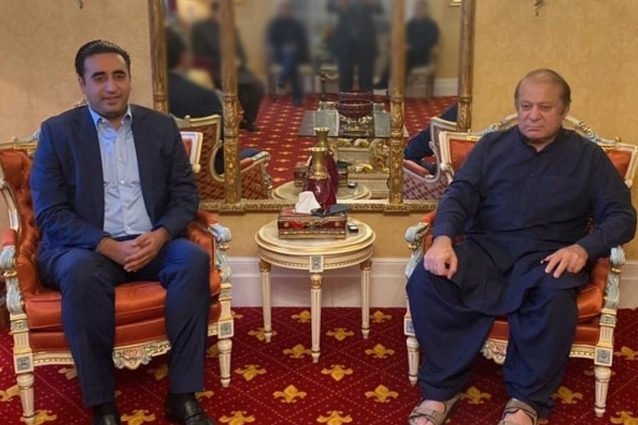
Nawaz and Bilawal mull sharing PM’s Office for 3, 2 years in post-elections talks. Amidst the swirling uncertainty following recent elections in the country, Pakistan’s top political heavyweights are engaging in a flurry of back-to-back meetings to forge a coalition government at the center.
With no clear winner emerging, key players are exploring avenues to ensure stability and effective governance.
In a significant development, the Pakistan Muslim League-Nawaz (PML-N) and the Pakistan Peoples Party (PPP) have entered discussions regarding the potential sharing of the Prime Minister’s office for the next five years.
Also read: PPP alleges rigging as Bilawal loses to Tarar in Lahore
Sources suggest that discussions between the two parties revolve around the possibility of alternating Prime Ministers from each party, with one serving for three terms and the other for two and a half terms.
This strategic dialogue took a significant step forward during an initial meeting over the weekend, where leaders from both camps delved into the prospect of appointing a Prime Minister for a condensed term as part of a broader effort to foster political stability in the wake of the recent electoral turbulence.
According to reports from local media outlets, both the PML-N and the PPP have reaffirmed their commitment to placing the interests of the nation and the welfare of its citizens above all else.
The ongoing discussions underscore a shared determination to navigate the complexities of the current political landscape while prioritizing the needs and aspirations of the Pakistani people.
Members of prominent political dynasties, including the Sharif and Bhutto families, have emphasized their steadfast dedication to amplifying the voices of the populace and translating their collective aspirations into tangible policy initiatives.
Meanwhile, the political arena remains charged with tension as Imran Khan’s Pakistan Tehreek-e-Insaf (PTI) initiates widespread protests alleging electoral malpractice in the recent general elections held on February 8.
Joining forces with other opposition parties such as Jamaat e Islami and the TLP, PTI members have taken to the streets, vehemently decrying what they perceive as electoral irregularities.
As Nawaz and Bilawal mull sharing PM’s Office for 3, 2 years in post-elections talks, the unfolding negotiations and protests underscore the high stakes and intense polarization characterizing Pakistan’s political landscape in this pivotal moment.
