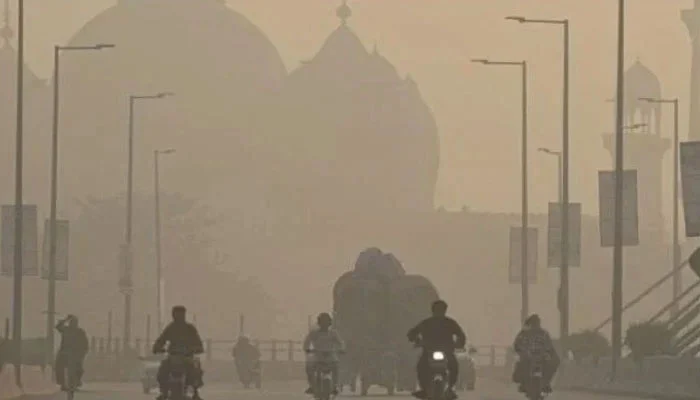
Smog is a type of air pollution. Originating from the phrases smoke and fog, the term “smog” was first used in the early 1900s. Sulfur and nitrogen oxides, ozone, smoke, rubbish fines, and other barely perceptible particles are the components of this kind of air pollution.
However, burning coal, smoke from factories and cars, burning agricultural wastes and forests, as well as other things like plastic, leather, rubber, and garbage, are the main causes of man-made pollution. Smog, as a broad term, refers to the kind of air pollution that is created when smoke and fog combine.
In general, smog is produced due to human unfriendly behavior, so it cannot be considered a natural process in any case. After summer, winter, autumn and spring in Pakistan and especially in the province of Punjab, smog is now considered the fifth season in some circles. Where the environmental changes happening in the world are a challenge for all of us, it is also very important for us to increase the joint efforts to solve the problems caused by these changes.
On the one hand, there is a dire need for immediate and effective measures to prevent smog, on the other hand, one can be protected from smog to a great extent by taking precautionary measures. If preventive measures are not taken, smog has very harmful effects on human health. Smog causes numerous diseases of the throat, nose, ears, mouth, eyes and breathing, which paralyzes the human body and is the biggest obstacle in creating a healthy society.
At the end of summer and the beginning of winter, a sense of welcome change is inevitable, but the smog over the past few years has put an end to that welcome change. For the last many years the smog starts from the end of October and continues till the end of November.
If it rains in the month of November, the smog dissipates quickly, but if there is no rain, it lasts longer. Due to climate change, the rainfall system has also been severely affected and the duration of rainfall has decreased drastically, which has aggravated the smog problem.
South Asian countries and particularly, Pakistan, India, and China are the most affected by smog. Some cities in these countries are badly affected by smog every year. Lahore, Beijing, and Delhi are among the cities where millions of people suffer medical problems due to smog every year.
Lahore, the second-largest and most polluted city in Pakistan, has been plagued by a heavy blanket of smog recently. The ever-growing urbanization and industrialization have contributed to the worsening air quality of the city. Smog, being hazardous to health, is leading to a rapid sprout in multiple health-related problems, as well as raising concerns about the long-term deleterious effects on public health. The current situation is expected to worsen due to the lack of an active action plan from the government’s side and a failure of concerned authorities to take note of the urgency of the situation.
Every country is taking measures to reduce the effects of smog and climate change. The International Health Organization is also trying in this regard. According to the World Health Organization, 77 million people die worldwide every year due to environmental pollution. Smog is a component of environmental pollution that is very important to get rid of as soon as possible.
Given the damage that smog can incur, it is imperative that prudent measures be undertaken to improve air quality. Most environmental regulatory organizations fall behind due to the lack of specialized equipment, standardized protocols, trained personnel, and funds. The government could start by allocating appropriate funds for monitoring and reducing harmful emissions, carrying out nationwide afforestation programs, and switching to renewable resources. Considering the bleak outlook that the current situation portrays, the need of the hour is establishing a stringent action plan to prevent adverse outcomes on public health and reduce the economic burden on the health sector of the country.
Last but not the least, the public needs to be made aware of the possible health issues that can be encountered during this environmental hazard and educated on ways they can protect themselves and prevent exacerbations of pre-existing medical conditions. Public service messages on television, radio, and the Internet, along with the distribution of educational pamphlets and brochures can be a few of the effective steps for ensuring this.
Thanks to the incompetent government that is trying to hide its poor policies under the cover of smog, the schools are completely quiet today. The environment seems to have cleared up a lot. It is beyond our understanding to close down educational institutions to reduce environmental pollution and harm children’s education. Unfortunately, opening educational institutions to teach in this country is also a huge criminal act. I think steps are being taken to weaken this nation educationally. Sometimes in the case of corona virus and sometimes in the case of smog. Due to the wrong policies of the government, the country of Pakistan is becoming economically and educationally weaker day by day.
As the final term approaches in schools, schools are being closed to deprive students of their true potential.
Punjab is shut down for 3 days without thinking 80% of the people do daily labor and feed their children. Such slaves have been imposed on the country who do not bother to take advantage of modern technology. They are ruining the educational future of the children, once the schools were closed in the name of corona, that too when the disease ended, now the schools are closed in the name of smog. Who is responsible for the smog, who cut the trees and turned the whole country into DHA and private housing societies and closed the educational institutions because the slave-governors never want their generations to gain consciousness by getting knowledge, as they hate consciousness. Therefore, they don’t want an educated society. Due to the 3-day closure of Punjab, just imagine the educational and economic loss to the country.
Caretaker Chief Minister Mohsin Naqvi has said that smog will be reduced by having three days of holidays in educational institutions, due to holidays there is a difference in the level of smog. If it was said that schools are being opened only four days a week to protect children from pollution, it would have been true, but to say that smog is reduced by keeping educational institutions closed for three days can be called a JOKE because the pollution in the air It has already been added to, until it rains, it will continue to exist and harm people’s health.
It would be naive to claim that the real drivers of climatic disasters are only linked to weak laws and their enforcement, a lack of clear legislative planning framework, and a reactive planning approach, yet in actuality, they are also linked to the inefficient implementation of such laws/policies that result in a decline in the number of natural green spaces. This lack of both policies and their implementation has been systematically leading to the degradation and depletion of the natural green barriers, thereby endangering the urban ecology, human health, and wellbeing, and enabling destruction as a result of multi-climatic disasters on a rising scale, accentuating region’s vulnerability to natural catastrophes and the negative impacts of calamities in catchment areas.
Pakistan in general, and Punjab cities in particular, require immediate intervention to build a holistic approach to improve the urban system against the problems of a changing climate. Government should control pollution instead of closing schools. Brick kilns and smog emitting vehicles should be banned while rules to prevent pollution in the industrial sector should also be strictly enforced to secure the health of students as well as their educational future.
The precautions to be taken to handle the smog are crucial to be done. The cycle itself should be continuous in nature. Individual precautions and government-level policies are necessary to solve the issue.
INDIVIDUAL LEVEL PRECAUTIONS
The public can also take part in preventive measures alongside the government. Furthermore, people can take the following steps to stay safe while dealing with smog.
To reduce exposure, stay away from busy locations when you are outside.
If you must have to stay outdoors, wear a mask.
Water intake and rest beneath the shades while working outside.
Avoid hard labour outside.
Avoid driving and smoking to lessen personal share of environmental impact.
If you must drive, go slowly and utilise your headlights, fog lights, blinkers, and hazard lights—even if it is late at night.
When inside, seal all air inlets, including windows.
Asthma patients should always carry inhalers. Also, if you have chronic obstructive pulmonary disease or think your condition might worsen, keep your doctor’s phone number handy.
Always keep your inhaler close if you suffer from chronic obstructive pulmonary disease or asthma. If your situation worsens, have your doctor’s number handy.
It is important to remember that pollution affects everyone differently, and some people are more vulnerable to its harmful effects.
On days with heavy fog, those with asthma, children, and the elderly should exercise extra caution.
Bike riders must wear face masks and eye protection. Keep your eyes clean and drink lots of water.
GOVERNMENT POLICIES TO BE IMPLEMENTED
The government needs to implement long-term plans to avoid smog permanently. Effective precautionary measures are as follows.
Permanent reduction in the usage of toxic fuels
Permanent reduction in vehicular emissions
Optimised traffic management program
An effective network of public transport
Reduction in waste burning
Avoidance of Crop Burning
Implementation of modern technology for old brickworks
Planned urban development
Increase in plantation
Evacuate the old vehicles
Agreements for regional environmental protection
Smog affects everyone differently; some people are more vulnerable to its harmful effects than others. Smoke, fog or Smog in Lahore has severely affected the people. It is crucial to take preventive measures on an administrative and personal level to combat the smog in Pakistan.
