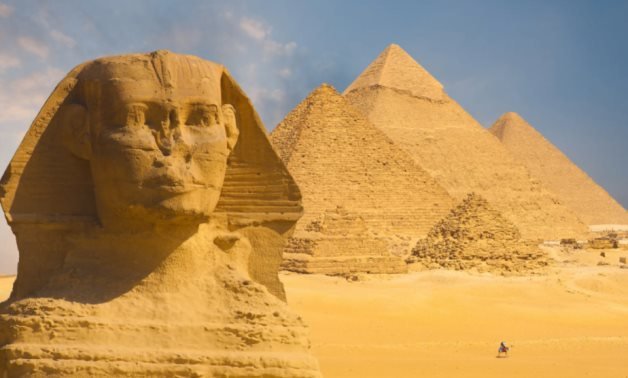
US scientists reveal origin story of Egypt‘s Great Sphinx Statue. In a groundbreaking study, researchers at New York University have proposed a new theory on the construction of the ancient Great Sphinx in Egypt, suggesting that erosion, rather than human handiwork, might have played a pivotal role in shaping the iconic limestone statue more than 4,500 years ago.
For decades, experts had maintained the belief that skilled stone masons likely hand-carved the detailed face of the Sphinx.
However, this recent study, led by senior author Leif Ristroph, challenges this long-held notion.
Ristroph’s team conducted laboratory experiments that revealed erosion caused by fast-flowing material could create Sphinx-like shapes.
“Our findings offer a possible ‘origin story’ for how Sphinx-like formations can come about from erosion,” stated Ristroph, emphasizing the surprising discovery from their experiments.
Also read: Smiling Sphinx statue unhearted in Egypt; resembles with Emperor Claudius
As US scientists reveal origin story of Egypt’s Great Sphinx Statue, according to the researchers, this newly proposed explanation not only implies that natural erosion might have contributed to the initial formation of the Sphinx but also suggests that this natural occurrence could have inspired the ancient Egyptians to craft it into a statue.
The study included an analysis of wind’s impact on unique rock formations, known as yardangs, found in desert regions.
To test their erosion theory, the team replicated the northeastern Egyptian terrain by using mounds of soft clay embedded with harder, less erodible material.
They simulated wind erosion by washing these formations with a fast-flowing stream of water.
Remarkably, the result of their experiment mirrored a Sphinx-like formation, featuring a lion’s “head,” an undercut “neck,” “paws” positioned in front on the ground, and an arched “back.”
Ristroph highlighted, “There are, in fact, yardangs in existence today that look like seated or lying animals, lending support to our conclusions.”
He also noted the potential implications for geologists, as the study reveals crucial factors influencing rock formations, particularly the influence of different material compositions on erosion-induced shapes.
The erosion theory proposed by the New York University researchers also resonates with a similar idea presented in 1981 by geologist Farouk El-Baz, who posited that the Great Sphinx might have originated from wind eroding the sand.
While this theory challenges the traditional understanding of the Sphinx’s construction, it’s important to note that the erosion theory, while innovative, may require further corroboration and analysis within the fields of Egyptology and archaeology to be widely accepted.
As with many scientific theories about historical monuments, this hypothesis will likely prompt extensive debate and exploration within the academic community, shaping ongoing discussions about the origins of this ancient wonder.
