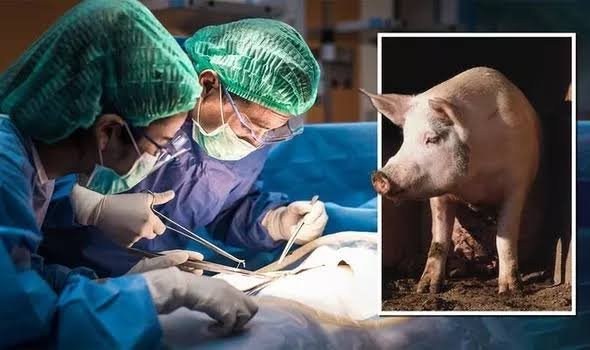
US surgeons win as pig kidney survives in human for over a month.
Health specialists reported that after the transplantation of a genetically engineered pig kidney into a human, the organ lived for almost a month in a brain-dead patient in the United States without signs of failure, as researchers investigate methods for successful cross-species organ donation.
Robert Montgomery, director of the NYU Langone Transplant Institute, told reporters: “We have a genetically-edited pig kidney surviving for over a month in a human.”
Also read: Indian surgeon revives ‘medically dead’ passenger mid-air
US surgeons win as pig kidney survives in human over a month, in September 2021, Montgomery performed the first genetically engineered pig kidney transplant on a person, followed by a similar treatment in November 2021.
“I think there’s a very compelling story that exists at this point that I think should give further assurances about starting some initial studies… in living humans,” he stated.
There have now been a few more occurrences, with all of the studies lasting two or three days.
While previous transplants have involved up to 10 genetic modifications, the latest saw just one: in the gene involved in the so-called “hyperacute rejection,” which would otherwise occur within minutes of an animal organ being connected to a human circulatory system.
By “knocking out” the gene responsible for a biomolecule called alpha-gal — a prime target for roving human antibodies — the NYU Langone team was able to stop immediate rejection.
“We’ve now gathered more evidence to show that, at least in kidneys, just eliminating the gene that triggers a hyperacute rejection may be enough along with clinically approved immunosuppressive drugs to successfully manage the transplant in a human for optimal performance — potentially in the long-term,” said Montgomery.
They also implanted the pig’s thymus gland, which is located around the neck and is crucial for immune system education, in the kidney’s outer layer.
“This allowed immune cells in the host’s body to learn to recognize the pig’s cells as its own, preventing a more delayed rejection,” said Adam Griesemer of the NYU Grossman School of Medicine.
After removing both of the patient’s own kidneys, one pig kidney was implanted and began generating urine immediately.
Monitoring revealed that creatinine levels, a waste product, were ideal, and there was no evidence of rejection.
Importantly, no indication of porcine cytomegalovirus — which can cause organ failure — has been found, and the team plans to monitor the animals for another month.
Surgeons at the University of Maryland Medical School performed the world’s first pig-to-human transplant on a living patient in January 2022.
Two months later, he died, and the discovery of porcine cytomegalovirus in the organ was later blamed.
The donor pig was sourced from the Revivicor herd in Virginia.
The Food and Drug Administration authorized the herd as a source of meat for persons who are allergic to the alpha-gal molecule, which is caused by tick bites.
Because these pigs are bred rather than cloned, the technique may be scaled easily.
Current efforts are centred on pigs, who are regarded to be suitable donors due to their organ size, quick growth and numerous litters, and the fact that they are currently grown for food.
