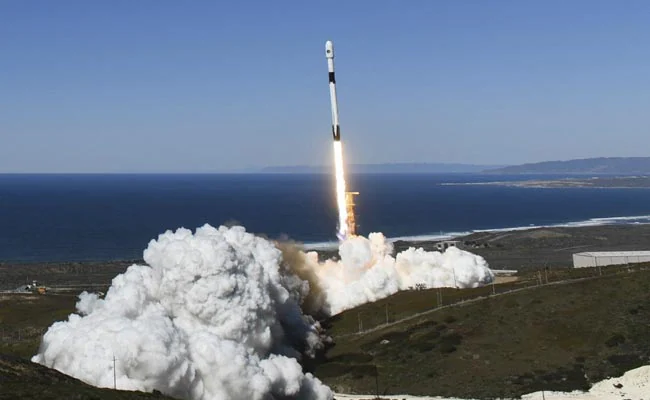
Elon Musk’s SpaceX rocket punches hole in Ionosphere. According to spaceweather.com, a rocket launched by Elon Musk’s SpaceX ripped a temporary breach in the ionosphere encircling our planet.
The Falcon 9 rocket lifted out from California’s Vandenberg Space Force Base on July 19.
It is a reusable, two-stage rocket designed to deliver people and payloads into Earth orbit and beyond, according to the company’s website.
SpaceX claims to be the world’s first orbital-class reusable rocket. Falcon 9 has launched 240 times and landed 198 times.
Photos from the July 19 launch revealed a faint red glow, which was investigated by Boston University space physicist Jeff Baumgardner.
After reviewing the launch footage, he concluded that the red glow signals a hole in the ionosphere.
Also read: Twitter Blue Bird becomes ‘X’, 10 points how Twitter changed under Elon Musk
“This is a well-studied phenomenon when rockets are burning their engines 200 to 300 km above Earth’s surface,” Mr Baumgardner told spaceweather.com.
“I reviewed footage from the July 19th launch. It shows the second stage engine burning at 286 km near the F-region peak for that time of day. So, it is quite possible that an ionospheric ‘hole’ was made,” he added.
As Elon Musk’s SpaceX rocket punches a hole in Ionosphere, the ionosphere is a region of space that is filled with charged particles known as ions.
According to NASA, geomagnetic storms cause aurora, with solar plasma reacting with ions to produce the stunning hues seen in the sky.
The ionosphere is significant because it reflects and modulates radio waves that are utilized in communication and navigation.
A hole in the ionosphere can interfere with GPS systems, causing position accuracy to vary by a few feet. According to Newsweek, it was not particularly relevant at the time.
With increasingly powerful rockets, the influence of launches on the ionosphere may grow in the future, leading to more serious repercussions on GPS, according to the site.
“Humans are entering an era where rocket launches are becoming usual and frequent due to reduced cost by reusable rockets. Meanwhile, humans are developing more powerful rockets to send cargoes to other planets. These two factors will gradually affect the middle and upper atmosphere more, and that is worthwhile to pay some attention to,” quoted Charles CH Lin of the National Cheng Kung University in Taiwan as saying.
A similar incident involving the same rocket occurred previously.
According to Science Times, on August 24, 2017, Falcon 9 launched from Vanderberg Space Force Base with the FORMOSAT-5 payload.
Because of its lightweight, the rocket flew vertically rather than parallel to the Earth’s surface, causing shockwaves. As a result, it ripped a hole in the ionosphere’s plasma.
The same event happened when the Falcon 9 rocket was launched on June 19, 2022, according to the outlet.
