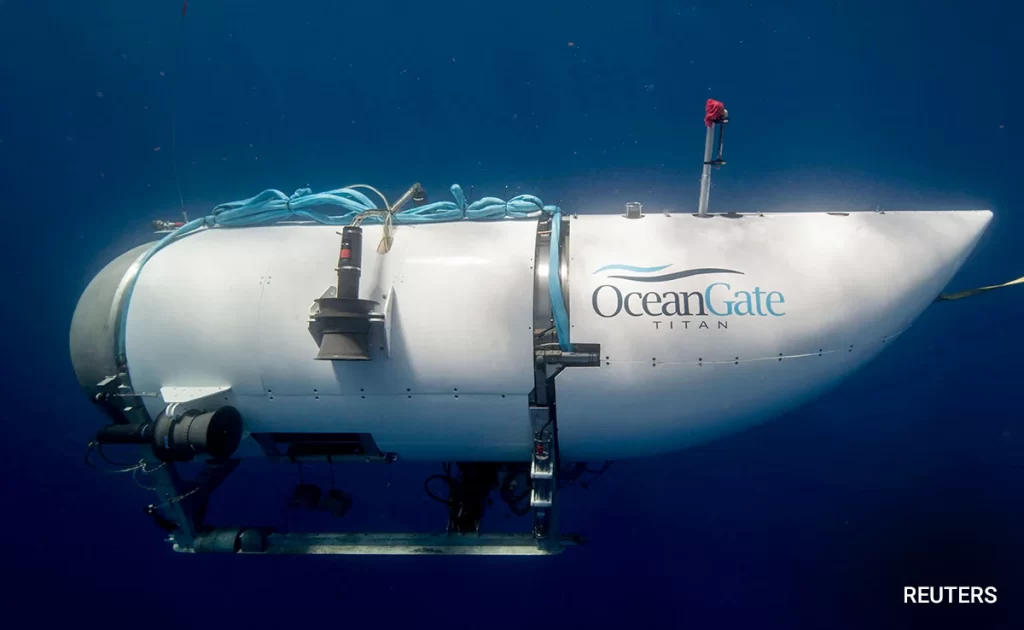
Titanic Sub crew dead after “Catastrophic Implosion”, confirms US Coast Guard.
The “catastrophic implosion” of their submersible claimed the lives of the five crew members who were on board when it went missing and was en route to the Titanic.
After examining debris discovered underwater earlier on Thursday by a remote-controlled vehicle, the US Coast Guard came to that conclusion. 1,600 feet (488 meters) from the Titanic’s bow, the debris was discovered.
“We immediately notified the families,” Rear Admiral John Mauger said at a briefing in Boston on Thursday. “On behalf of the US Coast Guard and the entire unified command, I offer my deepest condolences.”
Must read: What is Catastrophic Implosion, Likely cause of Titanic Sub’s destruction
An international fleet of ships and aircraft searched frantically a region of the North Atlantic that was twice the size of Connecticut as the Titan’s disappearance story captured the attention of the entire world. After the Titan lost contact with the Canadian research vessel Polar Prince on June 18, rescuers scrambled around-the-clock, worried that its estimated 96-hour oxygen supply was running low.
Unidentified sounds were heard during the search, the US Coast Guard reported earlier in the week, but they weren’t connected to the missing craft.
Stockton Rush, 61, chief executive officer of OceanGate Inc., based in Everett, Washington, which managed the expedition, Hamish Harding, 58, of the UK, Suleman Dawood, 19, and Shahzada Dawood, 48, a father and son from one of Pakistan’s most prominent families, and Paul-Henry Nargeolet, 77, a French maritime expert, were also on board the Titan.
“These men were true explorers who shared a distinct spirit of adventure, and a deep passion for exploring and protecting the world’s oceans,” OceanGate Expeditions, operator of the mission, said in a statement. “Our hearts are with these five souls and every member of their families during this tragic time. We grieve the loss of life and joy they brought to everyone they knew.”
The Titan, a 6.7-meter-long craft made of carbon fiber and titanium, was designed to carry a pilot and four crew to a maximum depth of 4,000 meters (13,120 feet). According to OceanGate’s website, an onboard system was able to track the health of the crew and provide “early warning detection for the pilot with enough time to arrest the descent and safely return to the surface.”
But no messages were received after a mothership on the surface lost all communications with the Titan on June 18, about 1 hour and 45 minutes after it began diving toward the Titanic, which sank in 1912 on its first trans-Atlantic voyage.
OceanGate says it offers 10-day expeditions to the Titanic site, providing “qualified explorers” the opportunity to join as mission specialists. Their fees underwrite the training and participation of the science team exploring the ship that sank in 1912 on its maiden transatlantic voyage after hitting an iceberg. OceanGate also ran expeditions to explore the wreck in 2021 and 2022, according to its website.
