How Greece migrant boat capsized?
At least 78 people have died and hundreds more are missing in this year’s deadliest refugee shipwreck off the coast of Greece.
The victims, almost all of them were men from Afghanistan and Pakistan, drowned when the huge trawler they were aboard capsized off the coast of the southern Peloponnese.
It was unclear how many passengers were missing from the ship, which had left eastern Libya on its way to Italy.
By the end of the night, Greece’s caretaker government had established three days of national mourning to commemorate the tragedy.
“There has been a dramatic rise in the death count, which is climbing by the hour,” said one Greek official.
“Speculation is rife that as many as 600 people were onboard but that has not been confirmed. The ship is under the water. It has sunk.”
About 104 passengers had been rescued as of Wednesday afternoon, he said.
How Greece migrant boat capsized?
According to Ioannis Zafiropoulos, deputy mayor of the southern port city of Kalamata, where survivors were transferred, there were more than 500 persons onboard.
A European rescue help organization estimated that roughly 750 individuals were on board, but the UN’s migration agency estimated as many as 400.
The search for survivors included coastguard vessels, a navy frigate, military transport planes, an air force helicopter, and a variety of private ships. Strong winds initially impeded rescue efforts.
According to survivors, the ship went down nearly instantly, close to the lowest section of the Mediterranean Sea, according to Greek media outlets.
“The engine stopped, and it sank in minutes,” one said.
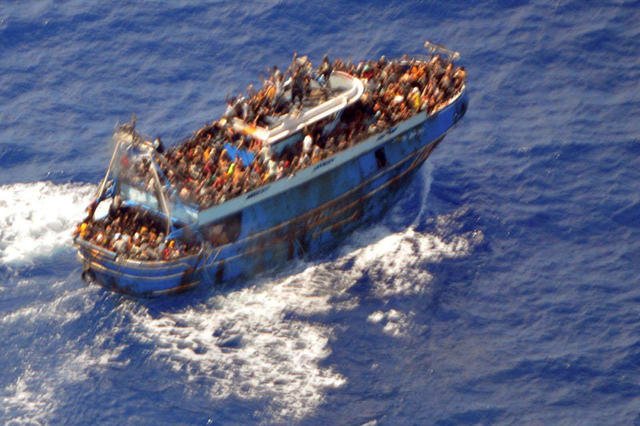
On Wednesday evening, the first aerial pictures emerged of the overcrowded vessel before it capsized. The blue trawler appeared to have hundreds of people on board.
“The outer part of the boat was full of people and we assume that was the case below deck too,” Nikos Alexiou, a spokesperson for the Hellenic Coastguard, told reporters.
“The boat was overcrowded. A precise number cannot with certainty be given but what is sure is that it is very big.”
Greek authorities and officials from the EU border agency Frontex were alerted to the stricken ship late on Tuesday. Repeated calls to the vessel offering help were declined, the coastguard said in a statement.
“In the afternoon, a merchant vessel approached the ship and provided it with food and supplies, while the [passengers] refused any further assistance,” the coastguard said.
A second merchant ship later offered further supplies and assistance, which were turned down, the agency added.
A coastguard patrol boat reached the vessel in the evening “and confirmed the presence of a large number of migrants on the deck,” the statement said. “But they refused any assistance and said they wanted to continue to Italy.”
Smugglers are taking more risks to avoid detection. They are increasingly using international seaways to deliver their human cargo to Italy rather than strongly guarded Greece.
“We are seeing growing numbers plying open seas that are more dangerous because they are prone to more stormy weather,” said Natassa Strachimi, a lawyer with Refugee Support Aegean, an NGO that provides legal aid to asylum seekers. “And the journeys are taking much longer because the destination is Italy.”
The Greek migration ministry criticized international smuggling networks for putting migrants’ and refugees’ lives in danger, while the UN High Commissioner for Refugees, Filippo Grandi, urged states to collaborate to build safe passageways for individuals escaping poverty and violence.
Greece has been chastised for forcibly deporting asylum seekers in breach of international law. Its former center-right administration, which is up for re-election later this month, has dismissed the “pushbacks,” describing its migrant policy as “tough but fair.”
Last month, a video surfaced showing refugees on the Greek island of Lesbos being forcibly loaded on a Greek coastguard vessel before being left adrift and picked up by the Turkish coastguard.
As the magnitude of the tragedy became clear, the country’s prime minister until May, Kyriakos Mitsotakis, and the leading leftwing opposition leader, Alexis Tsipras, said they would pause their electoral campaigns.
Ursula von der Leyen, President of the European Commission, expressed her sincere sadness at the incident.
Last week, EU interior ministers agreed to significant changes to migration legislation as well as a new partnership with Tunisia to restrict migration, with special money earmarked to minimise deaths in the Mediterranean.
According to UN estimates, over 72,000 refugees and migrants have arrived in the Mediterranean countries of Italy, Spain, Greece, Malta, and Cyprus so far this year.
Greece has always been a major transit point for individuals fleeing war, persecution, and poverty in the Middle East and Asia.
