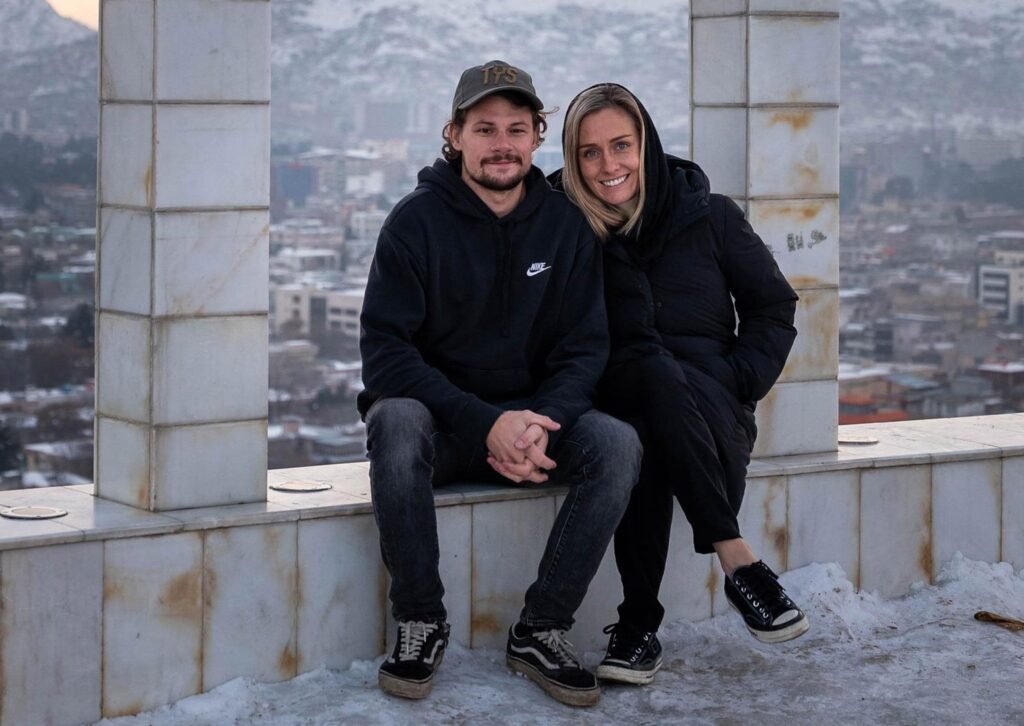
A pregnant New Zealand journalist who was stranded in Afghanistan due to her home country’s Covid-19 border policy claimed she will return home on Tuesday after her government finally offered her a way out.
After officials had previously requested that Charlotte Bellis reapply for a seat in the country’s overcrowded quarantine hotels, the government offer amounted to a backdown by New Zealand. Bellis had been provided a room voucher, according to Deputy Prime Minister Grant Robertson.
Bellis stated in a statement, “I will be travelling to my native country of New Zealand at the beginning of March to give birth to our baby girl.” “We can’t wait to get back home and be surrounded by family and friends at this momentous time.”
Her case had swiftly become a source of embarrassment for New Zealand, which has thousands of citizens languishing in military-run border quarantine motels.
Bellis expressed her gratitude to fellow New Zealanders for their support and stated that she will continue to push the government to find a solution to the country’s border controls. She also expressed disappointment that the decision was one-off and did not provide a way home for other pregnant New Zealanders.
On Sunday, she added that every day was a challenge. She stated she had sought unsuccessfully to enter New Zealand via a lottery-style procedure and then filed for an emergency return, but was denied. She is now 25 weeks pregnant.
The new offer was offered to Bellis because Afghanistan was exceedingly dangerous and there was a potential of terrorism, according to Chris Bunny, the chief of New Zealand’s quarantine system. He claimed that, especially since the withdrawal of US forces last year, there was a limited ability to assist civilians on the ground.
“We recognise that Ms Bellis believes herself safe and did not request an allocation based on that,” Bunny stated. “In rare and extraordinary cases, we have the residual discretion to grant allocations.”
Bunny stated that the case’s notoriety was not a deciding factor, and that Bellis’ safety was the only priority.
Bellis, 35, had previously worked for Al Jazeera, a Qatar-based television network, as an Afghanistan correspondent. Because it is unlawful to be pregnant and unmarried in Qatar, she resigned in November.
Bellis then travelled to Belgium in the hopes of obtaining residency in the country of her partner, freelance photographer Jim Huylebroek, who had spent the previous two years in Afghanistan. However, Bellis said that the length of the process would have resulted in her being stuck in Belgium with an expired visa.
She and Huylebroek returned to Afghanistan since they had a visa, felt welcomed, and could fight her battle to return to her homeland from there.
Officials in New Zealand said Huylebroek’s voucher would be added to Bellis’s if he flew on the same aircraft as her.
Since sweeping to power in mid-August, the Taliban have faced widespread condemnation for imposing oppressive policies on women, including banning females education beyond sixth grade. They have stated, however, that following the Afghan New Year in late March, all girls and women will be permitted to attend school. Thousands of female government servants have been denied the right to return to work, despite the fact that women have returned to work in the health and education ministries.
