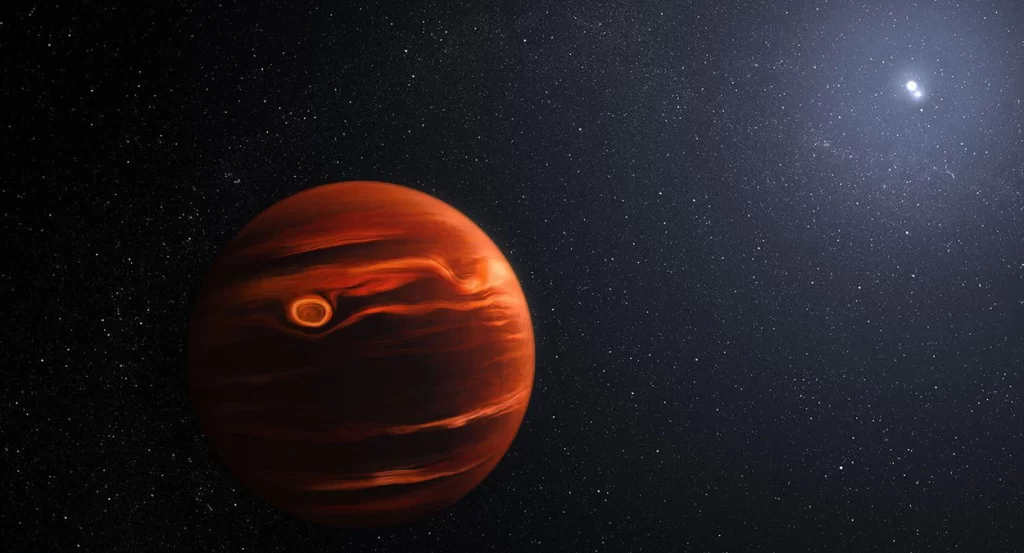
Scientists have witnessed a dying star swallowing a planet for the first time. A gas giant the size of Jupiter was eaten by a devourer star comparable in size to the Sun. A group of experts from the California Institute of Technology, Harvard University, and the Massachusetts Institute of Technology (MIT) reportedly saw the planet’s end.
The four inner planets will be swallowed up by the Sun when it turns into a red giant, therefore the event is significant because it provides a somber preview of what will happen to our world when that happens.
While astronomers have previously observed other stars before and after such an event, this is the first time the swallow itself was observed, according to the study published in Nature.
“The fact that the solar system planets would get engulfed into the Sun in the future was something I had read first in high school, so it was surreal to realize that we may have found the first ever example of catching a similar event in real time” study lead author Kishalay De, a postdoctoral researcher at MIT, told CNN.
Also read: Nasa’s Mars rover finds mysterious metallic object on Red Planet
Scientists observe a star swallowing a planet for the first time. The process, according to the experts, involves the huge star growing old and inflated to a million times its initial size as it exhausts fuel, swallowing up all the planets in its vicinity.
A star enveloping the planet, according to astronomers, is what generated what looked to be a white-hot flash, followed by a longer-lasting colder signal.
Mr. De witnessed the event in 2020 in the Aquila constellation, around 12,000 light-years away. The researchers needed a year to determine what the white-hot flash meant.
“One of the key pieces of evidence we were trying to understand is that the outburst was producing dust in the lead up to and after the outburst,” said Mr. De. “However, it takes time for gas to cool and condense dust molecules.”
The Sun-like star was around 10 billion years old.
