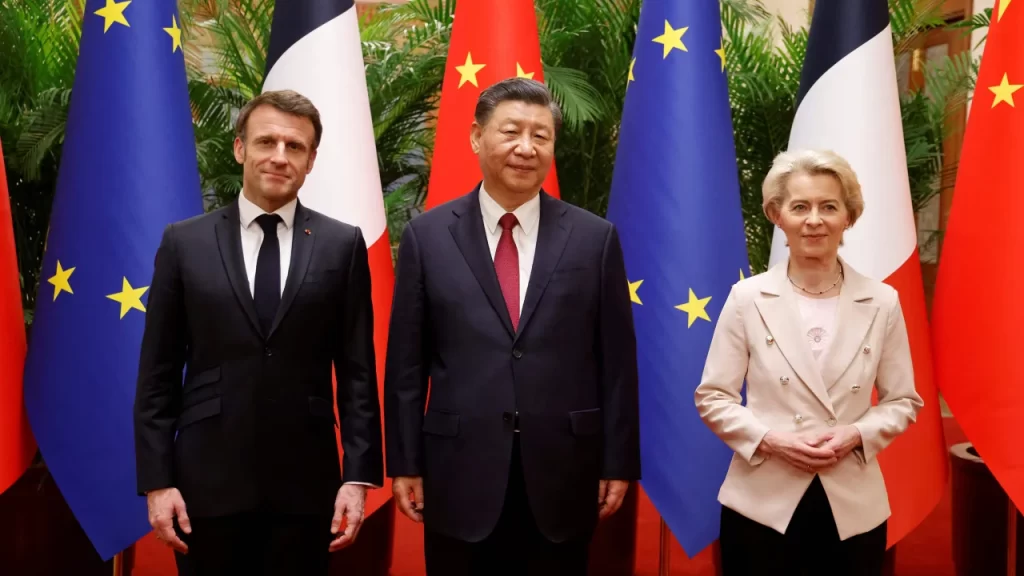
Since late last month the Chinese leader has hosted heads of state and government chiefs from Spain, Singapore, Malaysia, France and the European Union an unusual pace of diplomatic activity that comes as countries look to Beijing as the global economy sputters in the wake of the pandemic and war in Ukraine. List of leaders grew to visit Xi , should U.S worry?
On Friday, that list grew to include Brazilian President Luiz Inácio Lula da Silva, who is expected to sign a host of bilateral deals with Xi and, like several of the leaders before him, arrives with hopes of making progress toward ending Russia’s war in Ukraine.
But for Xi, this revolving door of visiting leaders making the trip even as China has refused to condemn the Russian invasion is also an opportunity to assert his vision for a global order not dictated by American rules and push back against perceived threats.
That’s especially urgent for the Chinese leader now, observers say.
Three years of scaled-back diplomacy due to China’s strict Covid-19 controls coupled with economic challenges, entrenched competition with the United States, and rising European concerns about Beijing’s foreign policy have left Xi under pressure to act.
“Chinese leaders believe it’s time now for China to make its strategic plans,” said Li Mingjiang, an associate professor of international relations at Singapore’s Nanyang Technological University.
“A potentially good outcome is to weaken American alliances so that’s why we’re seeing quite strenuous efforts made by Beijing to try to stabilize and improve relations with European countries, and also to try to improve and strengthen cooperation with emerging economies,” he said.
As world leaders return to Beijing despite international concerns over the growing China-Russia relationship and Beijing’s intimidation of Taiwan, Xi has used the opportunity to thread his conversations with veiled criticism of the US and keywords that signal Xi’s own view for how to reshape global power.
Speaking to Singapore’s Lee Hsien Loong late last month, Xi stressed that Asian countries together should “firmly oppose bullying, decoupling or severing industrial and supply chains,” while he urged Malaysian Prime Minister Anwar Ibrahim to “resolutely resist the Cold War mentality and bloc confrontation.”
To Spain’s Prime Minister Pedro Sanchez that same day, he warned that the “sound development of China-EU relations requires the EU to uphold strategic independence,” according to readouts from the Chinese side. List of leaders grew to visit Xi , should U.S worry?
Macron, who has long advocated for Europe to develop an independent geopolitical policy and defense capabilities that needn’t rely on Washington, appeared receptive.
He released a 51-point joint statement with China outlining cooperation in areas from nuclear energy to food security and told reporters traveling with him that when it comes to the US-China rivalry Europe must not be “caught up in crises that are not ours, which prevents it from building its strategic autonomy,” according to a Politico interview.
Macron’s comments have sparked a backlash in Europe and the US, but analysts say they were likely seen as a triumph in Beijing.
“Everything that can weaken the US, divide the West, and move countries closer to China is good for Xi,” said Jean-Pierre Cabestan, a professor of political science at Hong Kong Baptist University. “Hence, Macron’s trip is seen in Beijing as a major victory.”
Also read: Is China making peace while baring teeth
