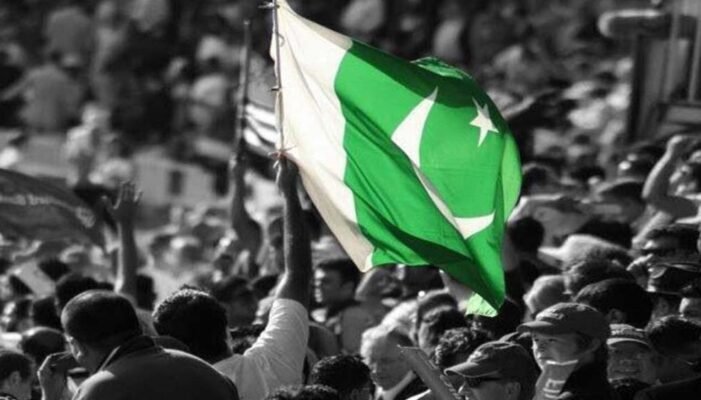
Civilians and the military have alternately ruled Pakistan, but the system has arguably remained “intact” due to democracy. One of the most complex debates concerns democracy, where it is easy to confuse the concept with practice, form with substance, and illusion with reality.
Another problem isn’t over yet. All countries at different stages of democratic development are called democracies. This adds to the confusion as we believe that all of these models are equally responsive to the needs of society. Non-targeted systems can be permissible and tolerated.
Democracy remains delusive and evasive in Pakistan. What we have looks like a democracy, but it doesn’t work that way. Democracy is a dynamic process, not a static process, but Pakistan’s ‘democracy’ is stuck.
Hopefully, if anything “good” comes out of the current crisis, it will be the popular belief that Pakistan’s problems stem from a lack of civilian hegemony or a lack of a “democratic system” that has been repeatedly disrupted by military rule. It is a recognition that I have been forced to do so. It may not be entirely true that the elected government was not allowed to complete its term.
The current crisis, and the way politicians are eagerly immersed in power struggles, tearing a burning nation apart, raises the question that the ‘democracy’ we have is part of the problem, not the solution. In fact, it is this “democracy” that has cycled over and over again, legitimizing bad governance and producing weak governments that oppose reform for fear of losing elections. Above all, there is a lack of substance.
Model and fabric
A true democracy has both model and a matter. Its model is manifested in an electoral democracy sustained by a process of free and fair elections and peaceful and orderly change of government. But models must embody good governance to empower people, free and representative institutions, constitutional liberal or other values-based systems, strong rule of law, and fairness and just. It is possible only if supported by a positive social order. That is substance. Without it, democracy remains empty. It has no soul.
Pakistan’s nobility, especially the liberal/secular strata, are most passionate about the Western liberal model, which focuses on freedom of choice, freedom of expression, civil liberties, an independent judicial system, and, of course, elections. Many of this class live emotionally distant from the rest of the masses, their brutal challenges of survival, and the means to meet them. Voila! They have a democracy and handle the problems of the state, including those of the poor.
Democracy and development
The secular liberal class as a whole, and the Western-oriented section in particular, believe there is a causal link between democracy and progress in the industrialized world. Therefore, they are entitled to pretend similar democratic political systems and set high expectations.
Their downside is that they don’t see the big picture. Most of them forget that democracy, which supposedly brought progress to the West, was more than just a political system. It was also the organizational idea of society, which included equal opportunity, fairness, rule of law, accountability, protection of basic human rights and freedoms, gender equality, and protection of minorities.
In short, the core idea of democracy was humanism. And the whole goal of giving people the right to choose who will govern them on their behalf was to ensure that that ideal came true.
Otherwise, what is the purpose of self-rule? Given the possibility of self-government, do people want to harm themselves in their politics? This was certainly not the intention.
It will never get there unless the state shows this basic understanding of democracy and takes steps to get it on the road to democracy. Otherwise, it will remain moving in circles or backward.
Democracy cannot feed ‘Poor People’
For many liberals in Pakistan, especially the wealthier ones, form is substance. It looks like democracy is simply black and white. There should be no gradation. In fact, Pakistan is democratic, but it’s not.
Pakistan’s democracy has progressed enough to satisfy liberals’ love of freedom and the enjoyment of certain human freedoms, but has declined to the point of being exploited by the elite at the expense of the people.
As the author of Thieves of State, Sarah Chayes focuses on corruption in Afghanistan. She spent ten years in Kandahar and presumes that most people’s concerns have little to do with democracy. Pakistan is certainly not Afghanistan, but the book has a message that applies here as well.
Democracy is arguably the best form of government, but asking the masses of societies grappling with serious state and state-building challenges is what matters most in their lives. The thing, they will say, is social and economic justice, human security and dignity, and hope for a better future.
A USAID official once asked what the people of Pakistan want Development or Democracy? The answer came quickly. They want democracy if democracy brings development. If not, they want development.
Fundamentally, we need a democracy that satisfies human aspirations for freedom and improves the overall quality of life of its citizens. Liberty is meaningless unless it guarantees the welfare and progress of society as a whole.
Pakistan’s ‘democracy’ is an instrument of political power
The concept of “democracy” is for Pakistan simply a way of preserving the wealth and status of the dominant social group. Another option is military administration. But the beneficiaries are about the same in both models – the spectrum of power, which consists of politicians, bureaucrats, the military and judiciary, and the top rank of “businessmen and landlords” who monopolize the country’s economic resources.
Civilian and military leaders can be rivals for power but ultimately work together to maintain the status quo. The military uses the failures of politicians as pretexts to gain or control power, and politicians use alibi of military chaos or control for their failures. They are both allies and rivals.
Daron Acemoglu and James Robinson, in “Why Nations Fail”, trace the evolution of political and economic institutions around the world, not because of geography or culture, but because of selective or inclusive institutions within states. It claims to be doomed to success or failure because of its emergence.
They write: “Exploitative political systems concentrate power in the hands of a limited elite and impose few restrictions on the exercise of that power often fabricated by this elite. As such, exploitative economic institutions are naturally closely related to exploitative political institutions. They must rely on an exploitative political system for…a political system that allows the elites who control political power to choose their economic system with little restraint from their opponents. They also enable elites to build future political institutions and their development.”
In light of their claims, powerful groups and institutions have long controlled Pakistan’s political body by exploiting Pakistan’s security concerns, the status of religion in the nation’s makeup, and its feudal social structure. The political institutions that emerge from this political system are designed to empower only the powerful and privileged and do little to promote the rule of law.
A musical chair game
Although civilians and the military have alternately ruled Pakistan, “faultless” by democracy, the system will undoubtedly remain the same. There has been no fear of accountability and no obstacles to privilege. They didn’t need humans, so they did very little for them. Neither they faced the full public outrage because they shifted the blame onto others.
When the cost of maintaining a civilian-led “democracy” becomes prohibitive, we tolerate military intervention to help remove it. However, the troops stay instead of going back to the barracks. Then we crave democracy and it will fail us again. The fact is that no institution is solely responsible for the democratic misfortunes of Pakistan. They all provided each other with opportunities to gain power and support the system.
In the civilian version, which now includes the ruling coalition, politicians are divided into political parties but united by the elite. Now that the bloody power struggle is over, investment in the system will probably be the same regardless of which party is in power. It can confuse your system, but it doesn’t pose a threat.
Freedom and order
Even if Pakistan were to make Western liberal democracy fully operational, it would not solve the country’s fundamental problems. The fact is that the Western model of liberal democracy is too competitive. In their book “Intelligent Governance for the 21st Century”, Nicolas Berggruen and Nathan Gardels challenge the view that liberal democratic models are built-in good governance. Seeing this against the backdrop of the most diverse political and cultural contexts, especially the Chinese system, the author advocates a mixture of order and freedom.
Asked what he thought of Western democracy on The Charlie Rose Show, Lee Kuan Yew, an inaugural Prime Minister of Singapore when asked what he thought of Western democracy. He said the opposition had become so competitive and hostile that they tried to undermine the current administration all the time by lying or distorting facts to mislead the public to gain power.”It would be a sad day if Singapore had such a democracy”, he said.
In his famous Future of Freedom, Farid Zakaria wrote that Singapore has adopted its liberal constitutionalism, has limited political freedom, and is the most self-righteous country in the world.
In Pakistan, we tolerate civilian-military-led political and governmental structures rigged in favor of the elite, while exploiting the full freedom of the democratic system to play the game of politics at the expense of the people. It is astonishing to see that this behavior is an acceptable price to pay for being a “democracy”. Democratic systems have institutions that lack autonomy and integrity. They lack the moral strength to serve people, but they lack the ability to maintain the system.
You can see millions of good Pakistanis watching politicians coming and going every day on their TVs and cellphones as if they were solving the problems of the country. We forget that their struggles are about themselves, about each other.
Democratization is a revolutionary struggle
You can’t change what you don’t know. The formation of real democracy is a revolutionary struggle. And we must start by recognizing that the “democracy” we have will not solve our problems, no matter who is in power. Nor can we bet that this “democracy” will become a democracy by itself.
A democratized country does not change. They have changed and become democratic. In many respects, democratization is an uphill struggle, indistinguishable from the building of nations and states. Examples include progressive and civil rights movements in the United States, political and social movements in Europe, and the Meiji Restoration in Japan.
How will this change happen in Pakistan?
This is the subject of a broader and more complex discussion. In short: Pakistan has tremendous strengths: extraordinary resilience, faith-based optimism, a sense of exceptionalism, a vibrant media, and a promising civil society.
The country has tremendous talent: academics, journalists, writers (many of whom are internationally recognized), political activists, and retired civil servants (both civilian and military). They can inspire and mobilize younger generations who crave real change that can provide momentum and critical mass to social movements.
The country has tremendous talent: academics, journalists, writers (many of whom are internationally recognized), political activists, and retired civil servants (both civilian and military). They can inspire and mobilize young generations who crave real change that can provide momentum and critical mass to social movements. I am not advocating military or technocratic governments. Let the current political process continue with all its flaws. It cannot and should not be overturned, but it can weaken over time.
That will be the motive of the social movement, to remove the obstacles to genuine democracy in Pakistan. These included an inadequate focus on faith that fostered extremism and hindered openness and tolerance and feudal rule that hindered education, gender equality, openness to modern ideas, and credible political processes.
Not to mention the military superiority that led to the prioritization of security over development. The latter distorts national priorities and resource allocation. All of this is not a life-sustaining environment for democracy. Can we see true democracy in Pakistan? It remains to be seen what the answer is to this question.
