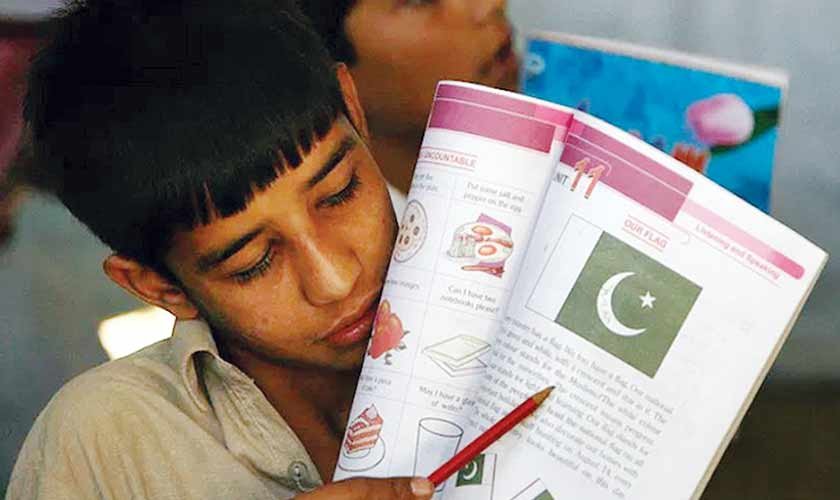
Although education is the most important social institution for the socio-political and economic development of society, Pakistan has been facing gigantic challenges. Pakistan has 40pc of the population illiterate, 22 million out-of-school children, 89 million people below the poverty line. Amidst such a grim scenario, there can be no two views that the country’s decaying education system needs reform. It’s also important to bridge the widening gap between various systems of education in the country. But the much-touted SNC does not serve either objective. The SNC has not addressed the fundamental objectives including, socio-cultural uplift of society, development of student-friendly curriculum, and the much-desired problem of unity. In fact, it is more of a leap backward than a step forward.
The first important issue is that our books are ‘frozen in history’ and are regressive. Tethered to cultural conservatism, it is impossible for a country to adapt to cultural changes needed for societal development. The new curriculum has reinforced the retrogressive content. One goal of the SNC is apparently related to the focus on values. But what are those values? What values are we trying to create through a retrogressive education system and textbooks presenting a distorted interpretation of history? Pakistan needs a cultural pragmatic society that must be unstinting to adopt cultural diversity in a global world. The country cannot develop with insular and imbecile mindsets. Many nations have become culturally pragmatic and adaptive, for example, China’s worldview is like that of 19th-century Protestants entirely future-focused and pragmatic. Notwithstanding the pride Chinese people take in their ancient science and civilization, there is no deep nostalgia and no calls for the resurrection of conservative values. The New curriculum is bound to reinforce conservatism rather than open the doors for cultural pragmatism.
Adding to this, more religious material has been included in subjects other than Islamiat, which is unfair to non-Muslim students. Further, the topic of Islam and minorities doesn’t seem to find a place in the SNC’s Islamiat outcomes. Ignoring such an important topic doesn’t seem to help bridge the gap, while excessive religious content in itself risks the misinterpretation of religious values that in turn may fuel extremism in society which is not desirable. There is, in short, little to commend the SNC. Islam is the code of life and offers the protection of minorities’ rights, for example, Allah says, “there is no compulsion in Deen.” 02:256. It implies the freedom of religion. Another place Allah says, ‘If any one of the polytheists seeks your protection, grant him protection.’ 09:06; ‘We have created you from a single pair of male and female.’ 49:13. These lessons by Islam must be included in SNC rather than overwhelmingly focus on rituals of religion.
- Another important issue that SNC fails to address adequately is gender-gap in Pakistani society. The need for awareness in Pakistan is clear. Education, being one of the agents of socialization, may yield productive results in narrowing gender-gap in Pakistan. According to research for the project, Safar-i-Hifazat conducted in 2020 in which 1,125 boys and girls aged 13 and 14 were engaged; 67 percent of project participants believed that experiencing emotions is not normal; 66pc were unaware about the right of divorce in a marriage contract, and 54pc of girls were unaware of physical changes during puberty. Interestingly, even brief exposure to life skills education led to significant improvements. For example, the number of youth who believed it was better to stay silent after being sexually abused dropped from 23pc to 4pc; awareness of self-esteem increased from 27pc to 47pc. Hence, by ignoring such an important issue, the curriculum could not resolve gender issues in Pakistan. The gender-inclusive Pakistan is the only way to progress Pakistan. In the words of Muhammad Ali Jinnah, “No nation can rise to the heights of glory unless your women are side by side with you… it is a crime against humanity that our women are shut up within the four walls as prisoners.”
Next to social issues, SNC fails to deliver on the economic requirements of post-Industrial societies. The education debate thus far excludes any meaningful discussion on how should students be taught science and technology. Given our ever-fragile economic situation, the educational system should not only produce consumers of science and technology tools (e.g drones, robots, and programming languages) it should also create makers of them. The minimum the education system can do for children is to teach them to use technology tools well. But the best it can do for our children is to teach them how to create these tools. It is important that this solid foundation is laid out in schools. In a digital world where the mode of production has changed to digitalization, Pakistan cannot make economic progress by depending only on the traditional mode of production (agriculture, industry). The SNC does not fix this problem by ignoring the development of technological skills.
In Addition, the world has shifted towards industrial and post-industrial societies that require a highly skilled labor force to reap the benefit of industrial and digital technology. Due to growing illiteracy, Pakistan is not exploiting the potential benefit of the industrial and digital economy. The digital economy includes the internet-based methods of generating economy, for instance, the use of startups and internet Giants as a modern tool for the development of the economy. The US is the largest country in terms of start-ups. In the US Facebook, Youtube, etc., inject billions of dollars into its economy. India is becoming the hub of startups with 38000 smaller and large startups that contribute massively to its economy. Pakistan has been lagging far behind due to a lack of entrepreneurship and innovation skills and full internet access that have deprived the country of its potential in the domain of the digital economy.
Further, Pakistan needs to shift its export base to High-tech industries. But problem is that these industries require high-skilled labor with adequate service skills. The education system can be productive in producing skilled labor in the information age. Pakistan’s education system desperately needs to pay focus on this domain. The balance of payment crisis is not going to be resolved if exports are based on raw materials and imports based on manufactured goods. Unfortunately, the new curriculum is silent on this aspect. Admittedly this will require time and maybe a gradual process, yet this is possible only when the foundation is laid down.
Unless these issues are made the part of SNC, we may have a curriculum but, after decades, we will be standing in the same position and the world will be many steps ahead.
