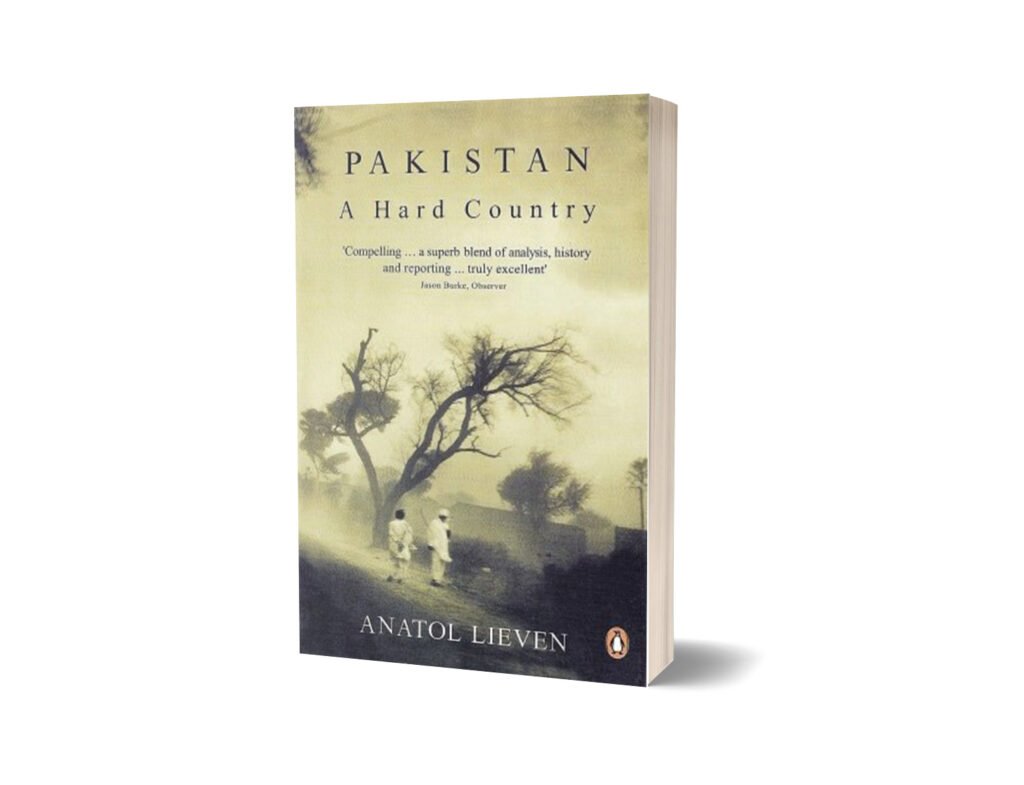
A British writer, who experiences the pure land for twenty years, meets people from the upper strata of the society to the lower one, takes interviews and visits the houses of the politicians and shrines of the holy saints, and writes down a masterpiece. In his book, Antol Lieven has infused his blood to make the body healthy, to feed each part of the body equal food.
Pakistan: A Hard Country amazingly deals with different kinds of topics through the lens of the lower and higher. Though I have read different books on Pakistan, it explores a new world. The book gives an excellent analysis of the contemporary issues prevailing since the dawn of Pakistan’s history.
The book contains four parts: Part one has an introduction to the Land, People and History. The Second Part has an in-depth analysis of the structure- Justice, Religion, The Military, and Politics. The Third Part explains the Provinces- Punjab, Sindh, Balochistan, and the Pathans. The Fourth Part unfolds the very critical issue which moves relatively following the growing tension with the neighboring countries, especially Afghanistan, and that are Taliban.
In the opening chapters, Antol Lieven has summed up Pakistan in two different phrases: [Weak State, Strong Societies]- the ever central force of kinship in Pakistan which is often seen as anti-revolutionary as well. [The Negotiated State]- The only possible solution for the miseries of the poor is negotiation with whoever is in power. This negotiation is often carried out through the references of local clans or the feudal and more realistically through economic giants.
Justice in Pakistan is an extension of politics and everyone with the slightest power to do so tries to corrupt and twist the judicial system to their advantage in every way possible. The reason for such a gloomy situation is the colonial background of the Subcontinent. Pakistan still works on the same old models which were designed by the British to control the uprising of the masses at that time.
For example, the Pakistani police still operate based on the British Indian Police Act of 1861. And also in courts, the use of English has alienated the population from justice owing to the British Raj. This is the reason why most ordinary people focus their attention on the Taliban or Jihadist groups for bringing Justice to them in the form of Shariah which results in great disillusionment.
In South Asia, particularly the region of the Subcontinent had immense importance with regards to religion- Islam. Islam in South Asia that developed by the saints through the preaching of the Holy Book. Despite having a glorious history of Islamic revival in the era of Jehangir, Pakistan from its very inception never enjoyed a pure Islamic state. The reason is very clear most forms of Pakistani Islam for their part are traditional and conservative- far too conservative to support a revolution, and far too diverse to submit themselves to a monolithic version of Islam- like in Iran. The sectarian division of Islam created by the colonizers to break the Muslim empire is still weakening the state.
The descendants of the saints, sorrowfully, could no longer maintain the pious duty and began to exploit their position to cater to their interests. These pir families have great political importance in Pakistan as most of the seats in the cabinet have always been occupied by these families. For example, as of 2010, the Prime Minister was Syed Yusuf Raza Gillani, deputy Prime Minister Makhdoom Amin Fahim; Foreign Minister Shah Mahmood Qureshi; Minister for Religion Syed Ahmed Qazmi. Even today the hold of these families on the government along with Shrines politics, and superstitions, the emergence of religious extremist political parties and fundamentalists are playing a significant role in deteriorating the image of Islam worldwide.
The military is considered the most disciplined well organized and united force in Pakistan. For most of the innocent masses, it also has a supreme position because of its assumed role of protecting the nation by offering the sacrifices of brave soldiers. Owing to its efficient handling of the worse situation, some civilian governments knocked on their door for help. For example, Both the Sharif and Musharaf administration has given charge of water, education, and reconstruction to put in place the order in the departments.
However, the military’s role in politics has also brought disorder in Pakistan. Intelligence Beaure along with the military and civil establishment has brought and toppled the regimes in the light of their interests. The Military’s growing patronage has also given rise to reservations. For example, the appointment of retired officers to senior jobs, the ability of officers to buy land on easy terms in DHA, and military-controlled business. In addition to it, the cantonments- originally built by the British to distance themselves from society- also indicate that they consider themselves superior to civilians. An army, in this way, constitutes a state within a state which controls the whole state.
Patronage and kinship form the basic elements of the political system- if water, chemically speaking, is H2O then Pakistani politics are P2K. This statement is the sum and substance of the politics of Pakistan. The incumbent government of every time has to support the landlord families by providing them jobs, lands, positions in the cabinet and establishing business industries for them. They have nothing to do with the miseries of the poor people because, for the single reason, they can be swept over by sentimental speeches. Religion is also used here as a tool to cool down the fires of poverty, malnutrition, joblessness, poor healthcare, and inefficient education. The lifestyle of politicians is so luxurious that they look indifferent to the hardships of the lower class.
Today’s Pakistan is more or less the old British legacy. The answer to the question is still in limbo that whether we have gained independence or not? Though the partition enabled the Muslims to have a separate homeland to practice the teachings of Islam, those teachings have never been given due place. The hold of one percent family throughout history in the form of the ruling political parties, and Washington allied military dictatorship have made Pakistan a hard country.
The views expressed in this article are the authors’ own and do not necessarily reflect The Asian Mirror’s editorial stance.
