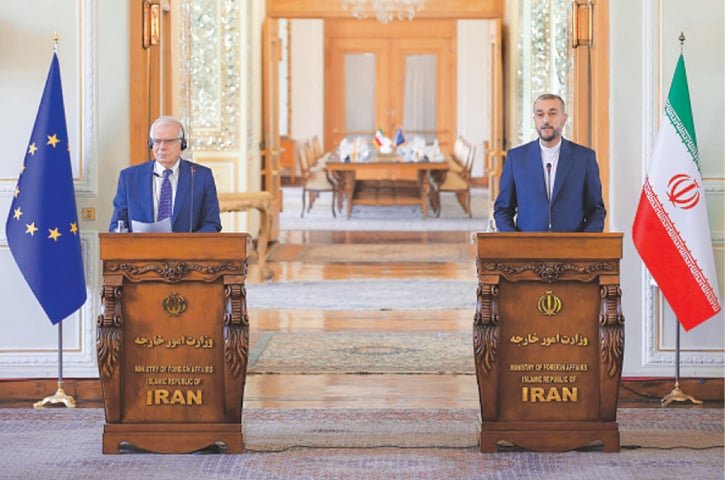
Relations between Iran and Europe have deteriorated sharply, with the EU and Britain ramping up sanctions against the Islamic republic over its response to more than four months of protests. EU, UK and US impose new sanctions on Tehran over protests.
Separately, the United States on Monday imposed sanctions on Iran’s Islamic Revolutionary Guard Corps Cooperative Foundation and senior Iranian officials, stepping up pressure on Tehran over its crackdown on protests.
Iran’s ties with the West have long been tense, over issues ranging from its contentious nuclear programme to its role in regional conflicts and the detentions of foreigners and dual nationals.
But ties have taken a turn for the worse as Iran has moved against what it labels “riots” sparked by the death of Mahsa Amini, 22, after her arrest for allegedly breaching Iran’s dress code for women.
Tehran has been infuriated by what it considers the tough stance taken by Britain, France and Germany, and accused Western powers of “inciting the protests and riots”.
The EU on Monday launched its fourth round of sanctions against Tehran since the protests started, placing 37 more Iranian officials and entities on an asset-freeze and visa-ban blacklist.
Britain on the same day sanctioned five more Iranian officials, broadening its list to 50 targeted Iranian individuals and organisations. EU, UK and US impose new sanctions on Tehran over protests.
The 27-nation EU has so far, however, stopped short of blacklisting Iran’s Islamic Revolutionary Guard Corps as a terrorist group, despite calls from Germany and the Netherlands to do so.
Iran has warned the bloc against such a step, and some EU officials are wary that it could kill off stalled attempts to revive the 2015 deal on Tehran’s nuclear programme.
EU foreign policy chief Josep Borrell insisted there needed first to be a legal ruling in an EU member state before the bloc could make the move.
Several European countries are also mobilising to obtain the release of their nationals detained in Iran, some held on spying charges.
Belgium and France, which both have citizens behind bars in Iran, on Monday denounced what they labelled Iran’s “policy of hostage taking”.
