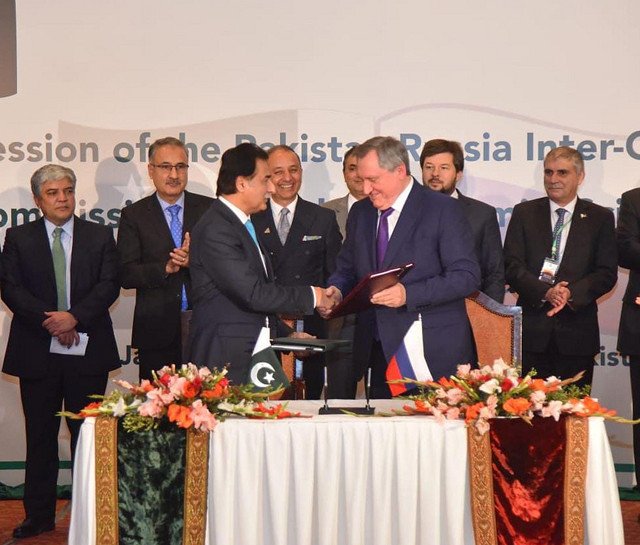
According to a senior Russian energy ministry official, Pakistan will pay for its energy purchases from Russia in the currencies of friendly countries.
The annual intergovernmental commission between Pakistan and Russia is taking place as Nikolay Shulginov, the Russian minister of energy, is in the nation. He also stated that the two nations have decided on late March as the deadline for crude oil export to Pakistan.
Based on mutually beneficial strategic and economic terms, Pakistan and Russia decided to expand their energy infrastructure investment, trade, and collaboration.
The agreement was made in Islamabad during the 8th meeting of the Pakistan-Russia Intergovernmental Commission. Russian Energy Minister Nikolay Shulginov and Minister of Economic Affairs Sardar Ayaz Sadiq jointly presided over the meeting.
Together with the Russian minister, Sadiq read from a joint statement that both parties had decided to collaborate on a thorough strategy for energy cooperation that would serve as the framework for future work. He added that the plan’s completion was scheduled for 2023.
Pakistan to pay for Russian energy in the currency of ‘friendly countries’ as the two countries decided that the oil and gas trade transactions will be set up in a way that is advantageous to both of them after reaching an understanding of the technical details. The procedure is anticipated to be finished in March of this year.
Furthermore, it was decided that the Pakistan Stream Gas Pipeline should be taken into account while evaluating comprehensive infrastructure and financially sound projects for the construction of a sustainable gas infrastructure that guarantees access to affordable gas.
According to Sadiq, Pakistan and Russia reaffirmed their commitment to a solid and cooperative economic partnership, emphasizing once more how this partnership benefited the economies of both nations as well as the wider region.
Additional areas of collaboration were looked into by the two parties. They planned to expand their collaboration in the fields of trade, investment, higher education, customs, communications, and transportation, as well as in the industries of railroads, agriculture, industry, and information technology.
The meeting emphasized that the relevant ministries and departments on both sides would closely monitor the situation in order to take advantage of the potential for shared prosperity in a number of sectors.
The Pakistani federal and provincial governments, as well as the public-private sector, invited the Russian side to possible initiatives. Russian businessmen were urged to take advantage of this chance.
They decided to designate focus points for discussions about Central and South Asian connectivity and logistics in order to strengthen their cooperation.
The two parties agreed to investigate the possibility further after talking about creative business practices, including barter.
The two parties reached an understanding to exchange information regarding creating and enhancing rail and road infrastructure for the sake of regional integration and Eurasian connectivity.
Both nations inked three agreements in the areas of aviation and customs-related issues following the event. More agreements were on the horizon, Sadiq added.
Earlier, Prime Minister Shehbaz Sharif received a special message from Russian President Vladimir Putin, who regards Pakistan as Russia’s major partner in South Asia and the Islamic world, emphasizing his country’s keen interest in deepening bilateral relationships as well as increasing trade and investment between the two sides.
The message was delivered by Nikolay Shulginov, the energy minister visiting Russia, who met with the prime minister in Lahore.
Both parties considered buying discounted petroleum products from Russia, as well as considering a long-term supply of oil and gas to Pakistan and assessing the gas pipeline project, during the meeting.
