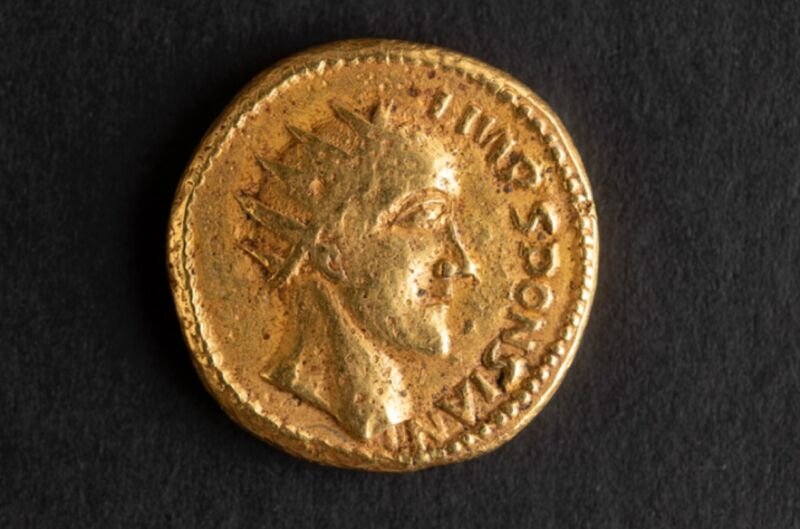
In 1713, a cache of Roman coins was discovered in Transylvania, several of which bore the portrait and name of Sponsian—but there are no historical records of a Roman emperor with that name.
The coins largely have been dismissed as forgeries for more than a century, but a re-analysis using a variety of physics-based methods has yielded evidence that they might be authentic, according to a recent paper published in the journal PLoS ONE.
So Sponsian may have been a real emperor after all.
One of the Sponsian coins is now in the Brukenthal National Museum in Sibiu, Romania; another is part of the Hunterian collection at the University of Glasgow.
“This has been a really exciting project for the Hunterian and we’re delighted that our findings have inspired collaborative research with museum colleagues in Romania,” said co-author Jesper Ericsson, curator of numismatics at the Hunterian.
“Not only do we hope that this encourages further debate about Sponsian as a historical figure, but also the investigation of coins relating to him held in other museums across Europe.”
Co-author Paul Pearson of University College London spearheaded this latest project—the first time a Sponsian coin has been subjected to scientific analysis.
Pearson saw photographs of the Hunterian coin while researching a book on the history of the Roman Empire during the pandemic.
He noted small scratches on the surface and thought this could be evidence that the coin might have been in circulation since coins carried about in purses or pouches tended to get scratched.
Pearson and his co-authors employed a range of analytic techniques for four of the coins from that 18th-century cache in the Hunterian collection, including the Sponsian coin and coins inscribed with the names of Plautius, Philip the Arab, and Gordian III.
The coins once belonged to one William Hunter, who likely acquired them from the estate of a well-known Viennese antiquarian named Joseph de France.
Those methods included classic light microscopy, ultraviolet imaging, scanning electron microscopy, and reflection mode Fourier-transform infrared spectroscopy.
They did the same for two other Roman coins whose authenticity had been confirmed for comparison purposes.
The analysis confirmed the presence of scratches and other signs of wear and tear commonly seen in genuine Roman coins.
Further, the chemical analysis indicated that all four coins had been buried in soil for centuries before being exposed to air.
Based on the analysis of Pearson et al., the Brukenthal National Museum has placed a Sponsian coin on public display as a genuine artefact.
“I believe we have established with a very high degree of confidence that they are genuine,” Pearson told the Guardian, although he admitted that the question of Sponsian’s identity was “more speculative.”
However, the authors believe Sponsian may have assumed command as imperator (“supreme military commander) of Dacia when the population was cut off from the rest of the empire, surrounded by hostile enemies.
Given their mining resources, Dacia could have minted their own coins with Sponsian’s image, which would have helped cement his authority and maintain economic stability and social order until the area was finally evacuated between 271 and 275 CE.
The research has received mixed responses from other experts.
Adrastos Omissi of the University of Glasgow told the Guardian that it was a “brilliant piece of work” and that he found the argument both for the existence of Sponsian and his role as a self-appointed ruler of Dacia quite convincing, especially since, at the time, “the bar for being an emperor was very low.”
But Richard Abdy, curator of Roman and Iron Age coins at the British Museum, did not mince words about his scepticism.
“They’ve gone full fantasy,” he told the Guardian. “It’s circular evidence. They’re saying because of the coin, there’s the person, and the person therefore must have made the coin.”
