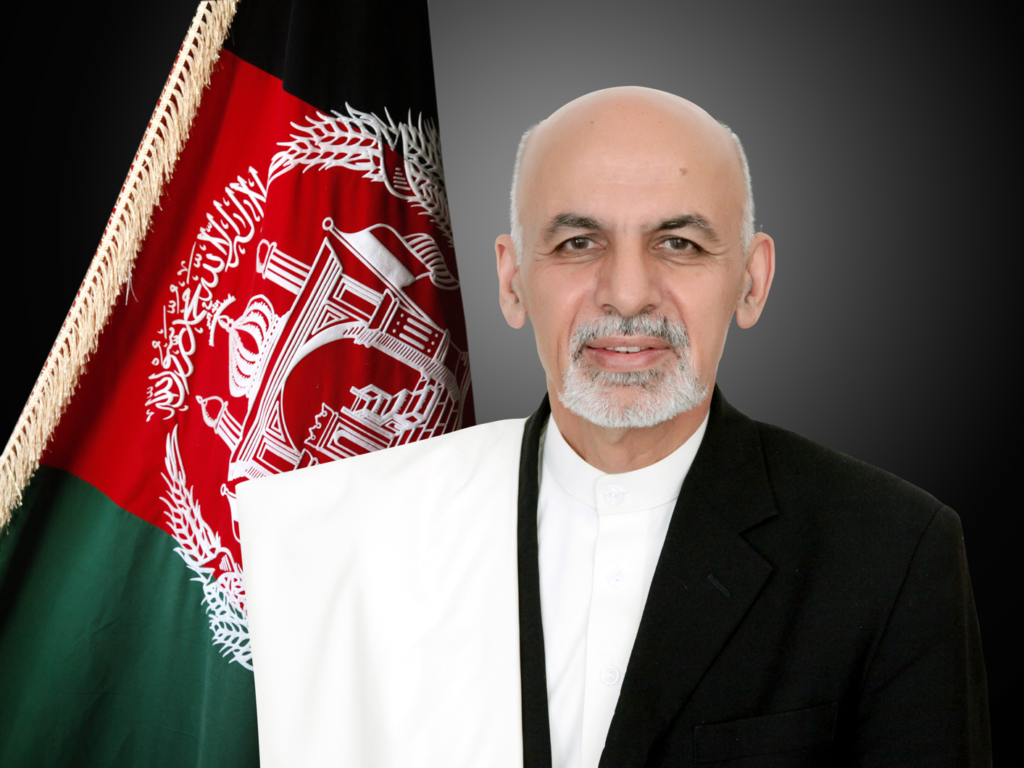
Afghanistan’s former President Ashraf Ghani said he had no option but to flee Kabul as the Taliban drew in and denied there was a deal in the works for a peaceful takeover, contradicting former Afghan and US officials’ testimony.
In a BBC interview aired on Thursday, Ghani said that an adviser gave him only minutes to decide whether or not to abandon Kabul, the capital. He also disputed allegations that he fled Afghanistan with millions of dollars in stolen cash.
Ghani’s abrupt and covert departure on August 15 left the capital adrift as US and NATO forces neared the end of a tumultuous 20-year presence in the country.
“I had no idea in the morning of that day that I would be leaving by late afternoon,” Ghani told BBC radio.
Other accounts contradicted what he said.
In an interview with The Associated Press earlier this month, former President Hamid Karzai said Ghani’s departure scuttled the chance for government negotiators, including himself and peace council chairman Abdullah Abdullah, to reach an eleventh-hour agreement with the Taliban, who had pledged to stay outside the capital.
Karzai said he invited the Taliban into Kabul “to protect the population so that the country, the city, doesn’t fall into chaos and the unwanted elements who would probably loot the country, loot shops” after calling then-Defense Minister Bismillah Khan, the interior minister, and the police chief and discovering they had all fled the capital.
However, in a radio interview with former British Chief of Defence Staff General Sir Nick Carter, Ghani claimed that he fled “to avert the destruction of Kabul,” stating that two opposing Taliban factions were closing in on the capital and were preparing to enter and fight for control.
When the Taliban arrived, there was no sign of the competing factions Ghani mentioned.
As a result of Ghani’s departure, an orderly transfer of authority was impossible, allowing the Taliban to easily fill the security vacuum. Many Afghans now accuse Ghani of simply handing them over to the Taliban while he is in the United Arab Emirates.
The Taliban, who had swept over most of the country in the days leading up to the assault into Kabul as Afghan government soldiers melted away or surrendered, rapidly grabbed possession of the palace.
According to humanitarian relief workers who were present at the moment and spoke on the condition of anonymity because they wished to speak privately, the Taliban moved to protect their compounds.
Despite billions of dollars in international aid over the 20 years that US-backed administrations had been in power, the Taliban takeover was met with widespread terror and a desire by many to abandon their severely poor homeland.
Afghanistan’s former president Ghani disputed allegations that he fled Afghanistan with a stash of stolen money in a BBC interview.
John Sopko, the US Special Inspector General for Afghanistan Reconstruction, has been tasked with looking into the allegations.
Several Afghan governments, as well as independent foreign and Afghan contractors, have been accused of extensive corruption, with dozens of reports by Sopko detailing the worst examples.
Since the ouster of the Taliban in 2001, which had harbored al-Qaeda and its commander, Osama bin Laden, Washington has spent $146 billion on reconstruction in Afghanistan.
Despite this, Afghanistan’s poverty rate was 54 percent even before the group returned in August.
President Alexander Lukashenko of Belarus was chosen the most corrupt, with Ghani, Syrian President Bashar al-Assad, Turkish President Recep Tayyip Erdogan, and former Austrian Chancellor Sebastian Kurz among the candidates.
Ghani said he decided to depart after hearing from his national security adviser, Hamdullah Mohib, that his personal protection men were incapable of defending him.
Ghani claimed that Mohib, who was “really afraid,” gave him only two minutes to decide whether or not to go, stressing that he had no idea where he would be transported even after he was on the chopper about to take off.
Afghanistan’s former president Ghani did not address the Afghan military’s rapid and swift defeat in the weeks preceding the Taliban takeover, but he did blame his government’s final fall on a deal the US had struck with the Taliban in 2020.
That agreement spelled out the terms for the ultimate departure of remaining US and NATO soldiers, bringing an end to the US’s longest conflict. It also included the release of 5,000 Taliban detainees, which Ghani claimed bolstered the Taliban’s forces.
