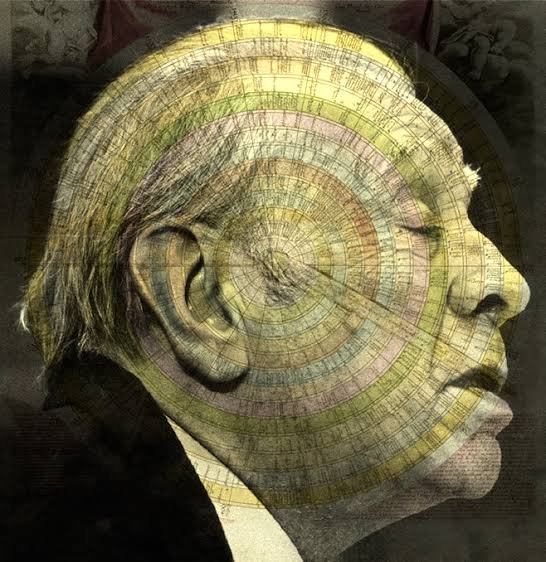
New Denial of Time: Borges on Paradoxical Dimension of existence
“Time is the element from which I am formed. Time sweeps me along like a river, but I am the river. A tiger devours me, but I am the tiger. A fire burns me up, but I am the fire.”
French philosopher Gaston Bachelard remarked, “If our heart were broad enough to adore life in all its detail, we would know that every minute is at once a giver and a plunderer,” in response to our paradoxical sense of time in the early 1930s. In her great investigation of time, place, and our thinking ego, Hannah Arendt stated fifty years later, “It is the insertion of man with his finite life span that changes the continuously running stream of sheer change… into time as we know it.” In other words, time is a construct of human consciousness and perhaps the very essence of human consciousness. We experience time, in particular the continuity of successive moments, as an inherent property of the universe.
Jorge Luis Borges (August 24, 1899–June 14, 1986), that hulking wrangler of paradox and grand poet-laureate of time, was sandwiched between Bachelard and Arendt. He addressed this conundrum in his 1946 essay “A New Refutation of Time,” which is still the most tasteful, learned, and enjoyable meditation on the subject to date. Later, it was a part of Labyrinths, a compilation of Borges’s stories, essays, parables, and other writings that was published in 1962 and gave rise to his brilliant and enduring fable of the divided self.
In contrast to his core theory, according to which time does not proceed sequentially and each moment encompasses all of eternity, negating the whole concept of “fresh,” Borges begins by pointing out the purposeful absurdity of his title. He observes that the title’s “slight parody” is intended to demonstrate how “our language is so saturated and animated by time.” With his signature self-effacing warmth, Borges warns that his essay might be “the feeble artifice of an Argentine lost in the maze of metaphysics” or “the anachronistic reductio ad absurdum of a preterite system” — and then he goes on to deliver a masterwork of rhetoric and reason, carried on the wings of uncommon poetic beauty.
As he reflects on his lifelong struggle with time, which he considers the foundation for all of his books, in the mid-1940s, a quarter century after Einstein defeated Bergson in their famous debate, in which science (or, in Borges’ words, “the clarity of metaphysics”) finally expelled the dictatorship of metaphysics from the contested territory of time:
“In the course of a life devoted to writing and (at times) to metaphysical confusion, I have seen or predicted a rebuttal of time that I myself do not believe in but that frequently visits me at night and in the wearying darkness with the illusory force of an axiom.”
The foundation of our experience of personal identity, according to Borges, is time. Philosophers first focused on this idea in the 17th century, followed by poets in the 19th, scientists in the 20th, and psychologists again in the 21st.
The leading proponent of idealist metaphysics George Berkeley, an Anglo-Irish philosopher, is compared by Borges to his Scottish counterpart and contemporary David Hume. Berkeley supported personal identity as the “thinking active principle that perceives” at the core of each self, while Hume rejected it, contending that each person is “a bundle or collection of different perceptions, which succeed each other with an inconceivable rapidity.” However, both agreed that time is real.
Borges charts the relationship between time and what he refers to as “this fragile universe of the mind” as he navigates the philosophical maze:
“A world of ephemeral perceptions; a world without matter or spirit, neither objective nor subjective; a world lacking the perfect architecture of space; a world created of time, of the absolutely uniform time of [Newton’s] Principia; a never-ending maze; a mess; a dream.”
Lisbeth Zwerger’s artwork was created for a special edition of Alice in Wonderland.
Borges thinks on how Hume’s concept of the illusory self, which was first put forward by Eastern philosophy millennia before, undermines the fundamental idea of time as we understand it:
“We are just the collection of these fictitious acts and these erroneous impressions; there is no hidden self that controls our actions and receives our impressions.”
However, Borges asserts that even the idea of a “series” of deeds and perceptions is deceptive because time is inextricably linked to matter, spirit, and space.
“I’m not sure how we can keep the continuity of time after matter and spirit, which constitute continuity, are negated, along with space. In addition to not being outside of each perception, whether real or hypothetical, neither does spirit, nor does matter, nor does time exist outside of the present.”
New Denial of Time: Borges on Paradoxical Dimension of existence
He leads us through a specific, well-known literary moment to highlight the paradox of the present, which is a paradox present in every present moment.
Huckleberry Finn wakes up on one of his evenings on the Mississippi; the raft is lost in dim light and is moving downstream; it may be a little chilly. Huckleberry Finn notices the gentle, never-ending murmur of the water; he carelessly opens his eyes; he sees a hazy line of trees and a smattering of stars; and then he falls back into his forgettable sleep as into the ominous waters. I contend that it is no less illogical to believe that these perceptions are terms in a series whose beginning is as inconceivable as its end. Idealist metaphysics claims that adding a material substance (the object) and a spiritual substance (the subject) to those perceptions is risky and pointless. For idealism, it is unjustifiable to add another perception to that immediate network of perceptions, such as the idea of another substantive river and another bank. For me, it is equally unjustifiable to add a chronological precision, such as the fact that the aforementioned event occurred on the night of the seventh of June, 1849, between ten and eleven minutes past four. In other words, I deny the huge temporal series that idealism admits using its justifications. I deny the existence of a single time in which all things are connected as in a chain, just as Hume denied the existence of an absolute space in which all things have their place. Denying coexistence is just as difficult as denying succession.
One of the few pictures by Norman Rockwell for The Adventures of Huckleberry Finn
As a type of humanitarian credo for the universality of human experience, this simultaneity of all events has enormous ramifications, which Borges wonderfully captures:
“Fires, wars, and epidemics are but one single anguish that is illusorily multiplied in many mirrors,” said Plato.
With paradox, Borges returns to the beginning of his argument and, one could argue, to the foundation of his entire body of work. He claims:
“But even so… Denying the passage of time, one’s own existence, and the cosmic world are both outward manifestations of despair and inner comfort. Our fate is terrifying not because it is unreal but rather because it is unchangeable and unstoppable. The material I am made of is time. Time washes me along like a river, but I am the river; it kills me like a tiger, but I am the tiger; it burns me up, but I am the fire. Unfortunately, the universe exists; so, I am Borges.”
The essay, as everything in Labyrinths, is an exceptional read in its continuous entirety; excerpting, fragmenting, and annotating it here fails to dignify the agile integrity of Borges’s rhetoric and the sheer joy of his immersive prose. Complement it with Bertrand Russell on the nature of time, Virginia Woolf on its astonishing elasticity, and Sarah Manguso on its confounding, comforting ongoinginess.
