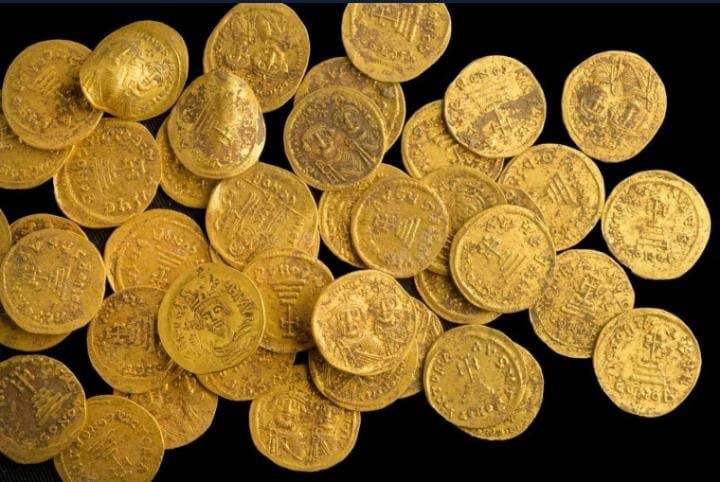
Archaeologists found 44 hidden gold coins from the Byzantine Empire.
When someone hid 44 gold coins in a wall in the 7th century, they may have hoped to one day return and find their treasure.
Instead, the pieces were found nearly 1,400 years later by Israeli archaeologists, who hailed the find as a rare glimpse into an ancient past during a tense period of violent conquest.
The Israel Antiquities Authority said it found the treasure in Banias, once known as Panea, which has been an important spiritual site for successive cultures throughout history.
Weighing around 170 grams (6 ounces), the pure gold coins depict the effigies of emperors Phocas (AD 602-610) and Heraclius (AD 610-644). Experts believe they were made during the Muslim conquest of the region in 635.
“The discovery reflects a specific moment when one can imagine the owner hiding his fortune at the peril of war, hoping to one day return to reclaim his possessions,” said Yoav Lerer, who led the excavations, in a statement.
“Looking back, we know he was less fortunate.” The coins also reveal new details about the economy of the last 40 years of Byzantine rule in the region.
As archaeologists found 44 hidden gold coins from the Byzantine Empire, the Byzantine Empire, centred in what is now Istanbul, was a continuation of the Roman Empire after its collapse in the West following the sack of Rome by the barbarian tribes in 410 AD.
The Eastern Empire would have lasted another 1,000 years but lost some of its provinces to the Muslim conquests of the 7th century, around the time the coins were stowed in the wall.
“Most of the coins belong to the Byzantine Emperor Heraclius,” said Gabriela Bijovsky, an ancient coins expert who examined the treasure in a press release.
