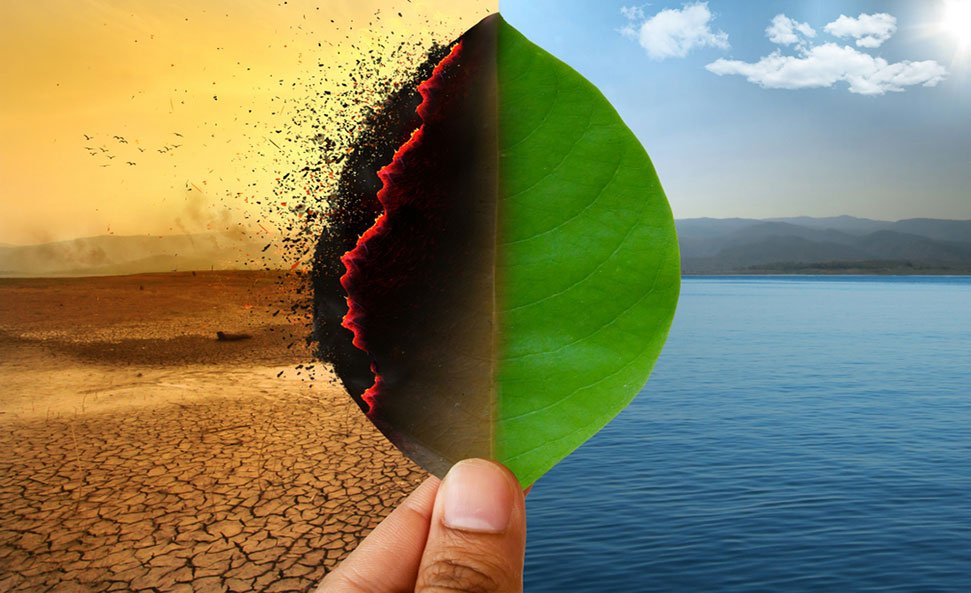
This year climate change has wreaked havoc in the world more than ever. From chronic heatwaves to torrential rains and the floods, disasters, calamities, and landslides caused owing to them, many parts of the world have witnessed many worst weather events within a very short period of few months. Climate change is increasing at an accelerated speed, more than what climate scientists expected. What climate scientists estimated and forecasted in 2020 to happen in the next 30-40 years happened just in a couple of years recently in the United Kingdom (UK) when the temperature exceeded more than 40 degrees Celsius for the first time. However, despite the warnings by scientists to cut the greenhouse gasses especially emitted from fossil fuels for electricity, heat, and transportation, the entire world seems non-serious about it and there is not much attention paid to it.
Pakistan is situated in the Hindu Kush Himalaya region with some of its western and north-western parts directly home to the mighty mountain ranges. While its eastern parts lie in the Indus river basin which originates from these mountains. The impact of global warming is increasing in the Himalayan region. According to the Intergovernmental Panel on Climate Change’s (IPCC’s) sixth assessment report of 2022: impacts, adaption, and vulnerability, “Mountains are highly significant regions in the context of climate change and sustainable development at the intersection of accelerated warming and a large population depending directly or indirectly on them. Climate change impacts on mountains and their attribution to human influence have increased in recent decades with observable and serious consequences for people and ecosystems in many mountain regions. Observed changes include increasing temperatures, changing seasonal weather patterns, reductions in snow cover extent and duration at low elevation, loss of glacier mass, increased permafrost thaw, and an increase in the number and size of glacier lakes”.
One must have a look at Pakistan’s environment prior to 1971 to understand Pakistan’s climate vulnerabilities because that really has little bearing on what measures need to be taken to deal with the challenge of climate change. Of course, there are many lessons that post-1971 Pakistan can learn from what was also Pakistan pre-December 1971 — in its handling of the environment and climate change. For those interested in going back to trace the history, Ali Tauqeer Sheikh, in his Dawn column has clearly linked decisions that negatively impacted Pakistan to the autocratic rule.
Nevertheless, One must also bear in mind that the topic of environment and climate change is like an octopus with tentacles touching many things at the same time. The touch points are not limited to birds and bees, turtles and trees, but are as varied and sometimes seemingly unconnected as water, transport, irrigation, agriculture, construction, town planning, industry, governance, and health and education plus advocacy and awareness.
Nevertheless, in March, April, and May this year, the country witnessed chronic heat waves that it had never witnessed since its inception. However, the month of April was the hottest month in the last 61 years. This shows how climate change is worrying the country with the passage of time. These enduring and excruciating heatwaves did much harm, in terms of economic losses, to the country than it had ever expected. From spontaneous fires erupting in various forests of the country to the loss of millions of human lives and wild animals to the destruction of hundreds of millions of precious trees, all owing to these heatwaves. Owing to these heatwaves, fires erupted spontaneously in various forests of the country, burning trees and many wild animals into ashes. The most pertinent examples in terms of forest fires can be Balochistan and Khyber Pakhtunkhwa, which were the worst affected provinces of the country due to forest fires.
In Balochistan, a deadly fire had erupted in the pine [Chilgoza] forests of the Koh-e-Sulaiman Range. The Shirani forest, located a 4-hour drive from Quetta, is one of the largest fruit-bearing areas in the country, located in the Zhob division near the Balochistan-Khyber Pakhtunkhwa border. Spread over 26,000 hectares, it is home to more than 10.8 million pine trees, each worth over Rs20,000. Sadly, the fire in the Shirani Forest destroyed millions of these precious trees which is a huge economic loss for the country, which it cannot compensate for for years to come. Such spontaneous forest fires also erupted in the various forests of Khyber Pakhtunkhwa (KP), which also burnt wild animals and millions of precious trees into ashes. In fact, prolonged dry weather, severe heatwaves, and gusty winds added the proverbial fuel to these fires, which caused immense damage to Pakistan’s already fragile economy, displaced millions of people, resulted in the loss of livelihood for thousands, and exposed the fragility of response measures. The devastation in poor areas of Pakistan is enormous due to a lack of capacity, equipment, and awareness regarding climate change. Climate change is considered a major driver of these forest fires in Pakistan as soaring temperatures and dry weather rendered the ground biomass highly flammable. Suffice it to mention that Pakistan, which was once viewed as a paradise for tourism, is now losing its beauty and precious forests owing to the worst impacts of the growing climate crisis.
Furthermore, when these fires in both provinces were extinguished, the country was on its way to compensating for its economic losses. But, yet again, climate change destroyed all the hopes and preparation by striking in the shape of torrential rains. These rains have caused much more damage to the country than the spontaneous fires in the forests. Recent torrential rains and the floods, landslides, and calamities caused them have plunged the country into serious issues that it has never witnessed in past. The pertinent examples in this regard include the bursting of a number of dams across the country, the sinking of various cities, the collapse of many houses (leaving millions dead and millions homeless), etc.
Infrastructure has also been badly damaged countrywide, which is especially tragic when it comes to Balochistan, the most underdeveloped province of Pakistan, even before the floods hit. With large parts of the province cut off from all access, the true magnitude of the destruction will not be clear for many months but if NDMA figures are anything to go by, over 710 kilometers of metalled roads have been completely swept away. In absolute terms, however, it is the road system of Sindh that has been worst hit, with over 2,200km of roads destroyed. Many bridges and roads have been destroyed, disconnecting various parts of the country from the rest of the country. These rains have wreaked havoc in the country and proved that the country has never ever taken pertinent steps regarding climate vulnerabilities. The losses that these recent rains have caused have proved the unpreparedness of the country regarding the serious issue of climate change and that the country has never been concerned about it.
Moreover, apart from these, climate change is adding fuel to Pakistan’s Climate Refugee Crisis. People dwelling in climate hotspots are forcibly displaced owing to catastrophic impacts generated by climate change. Pakistan’s climate refugee crisis has gained momentum and triggered threats to the country more than ever with each passing year. Sadly, the recent rains have left dozens of families homeless across the country. Millions of people living in mountainous regions of the country are now forced to relocate to safer locations due to glacial lake outburst floods and fast-melting of glaciers. Whenever the glaciers melt, the meltwater accumulates and forms lakes. Later, these lakes overflow and cause catastrophic floods. The thing that gives us an edge over the rest of the world is that Pakistan has got more glaciers than the rest of the world. But, the trouble for us is that the fast melting of glaciers is causing great concerns that if the devastating impacts of climate change are not addressed at the earliest basis, Pakistan may not have glaciers in the next few decades to come, which is not a positive sign for the country.
Regrettably, coastal communities are at significant risk and fear for their existence. The locals of these areas have been compelled to switch their professions from farmers to fishers as their lands have been taken over by the sea due to rising sea levels. The things that have further enhanced their miseries is the unavailability of fresh and potable water in these areas due to the sea taking over their lands. They are also victims of the climate refugee crisis as they have to shift to safer places to spend life. Analysts have estimated Pakistan’s climate migrants over the past decade at around 30 million people. This number may increase in near future as climatic conditions in the country are getting worse day by day.
Arguably, climate change is no more a joke. It is a serious issue and has to be addressed seriously. Pakistan has weapons, arsenals, and even atom bombs to protect its territory from other hostile countries and terrorist organizations. However, the question to be asked is: what does it have to fight against a fast-changing climate and mitigate its harmful impacts, which is an existential threat to the present as well as the future of the country and is more dangerous than terrorism? Unfortunately, perhaps, the answer is a big “NOTHING”. The country finds itself in graver and graver problems as the clock ticks to more climatic impacts in near future with the recent spell of rains wreaking havoc and killing and injuring many. These rains and heat waves are harbingers of climatic conditions that the country will witness in the near or remote future.
It is high time for Pakistan to invest in preparedness to mitigate future protection needs and prevent further climate-induced disasters. Pakistan should learn lessons from recent catastrophic events of climate change in the country. Waiting for the climate disaster to strike is not an option. It is the need of the hour for the country to take it seriously and deal with it in that manner. If not done so, the country will, very soon, bear the brunt of it in the shape of horrific disasters. Climate change is no more a joke.
