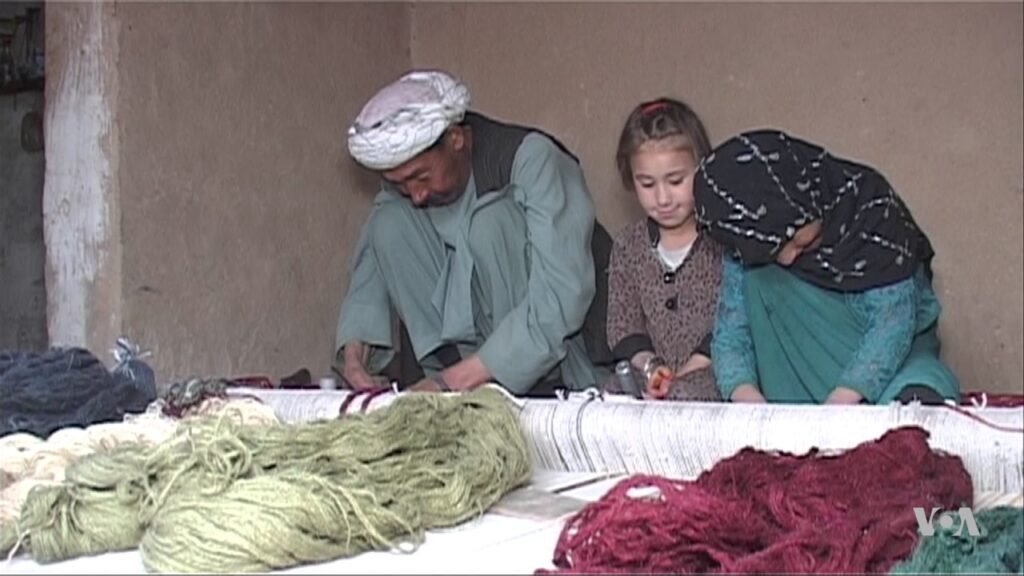
Four brothers of Afghan families find carpet making good with the aim of making a living as the country’s economy teeters on the brink of collapse.
The Haidari brothers now spend their days weaving the intricate rugs for which Afghanistan is famous, sitting side by side on a squat bench, as generations of their family have done before them.
As their country is going through a freefalling economy, Afghan families find carpet-making a good way to feed their children.
They put through long hours every day, putting on a brave front despite the fact that there is no assurance they will be able to sell their carpets.
Ghulam Sakhi, the family patriarch, said, “We have no other option” to keep the family alive.
The Haidari brothers had managed to avoid the backbreaking labor of carpet manufacture until August 15, when the Taliban retook power in Afghanistan, and were running a profitable company supplying flowers for weddings.
The fundamentalist movement’s austere view of Islam, on the other hand, effectively put an end to the expensive betrothals that Afghans adored, and the family business disintegrated. They turned to their family’s rug-making business as a creative response to misfortune.
“Naturally, wedding halls didn’t do well after the Taliban took power. That is why we have resumed carpeting “Rauf, the eldest of the brothers who all live and work in Kabul, is 28 years old.
He told AFP, “It’s a very old practice that our forefathers have passed down to us.”
They now pick silk strands from dangling spindles and loop them into the rug’s warp and weft with precise, rhythmic energy.
They expect the 12-metre (39-foot) carpet to sell for up to $6,000 when it is finished (5,300 euros).
According to Noor Mohammad Noori, the head of the national carpet makers’ association, almost two million of Afghanistan’s 38 million people work in the carpet industry.
However, he claims that demand has plummeted since the Taliban’s takeover triggered an exodus of expatriates working for foreign organizations.
Afghan carpets are sought after all over the world, from beautifully woven silk Persians to simple tribal kilims.
However, “more and more people are making carpets” in recent months, according to Kabir Rauf, a Kabul merchant who describes his wares as “national treasures of Afghanistan.”
Women who are unable to work, girls who have been expelled from school, and unemployed males are among the newcomers to the carpet-weaving sector, he said.
Haji Abdul Qader’s carpet-making enterprise in Herat, close to the Iranian border, already employs over 150 families.
Every day, though, two or three additional people who are desperate for a job contact him. Even people with no prior experience contact us.
Rauf Haidari stated, “There is no other employment.”
Those with skills, on the other hand, have an opportunity to make a living.
“A carpet weaver would never be out of employment,” says Muhammad Taghi, whose family has worked with Haji Abdul Qader for a decade.
Taghi used to weave when he was younger, but now his four children, ages 17 to 24, are in charge of making carpets next to the stove in the family house.
They’ll need 120 days to complete four matching two-by-three-meter carpets, which will reward them with approximately $500.
“This effort makes me proud. We create these carpets in our country, which will be sold all over the world as Afghan carpets “Muhammad Taghi stated the following.
“With this money, I can send my daughters and sons to schools and universities.”
Nassim, his youngest son, who began weaving at the age of ten, is still in school and aspires to be a doctor.
The carpet merchants, on the other hand, have their own set of issues as a result of the supply glut.
Haji Abdul Qader, who receives roughly five carpets per week, stated that bank withdrawals are limited to $400 per week.
“I’m concerned I won’t be able to pay the manufacturers.”
There aren’t many customers, either.
“Foreigners aren’t buying them,” Kabir Rauf grumbled as he sat idle in his Kabul market stall surrounded by hundreds of carpets.
He described the exodus of international organizations in the aftermath of the Taliban’s return as “the worst time” for business, but he remained optimistic.
Airlines to the Gulf have been restored, and his carpets can now fly all over the world from there.
