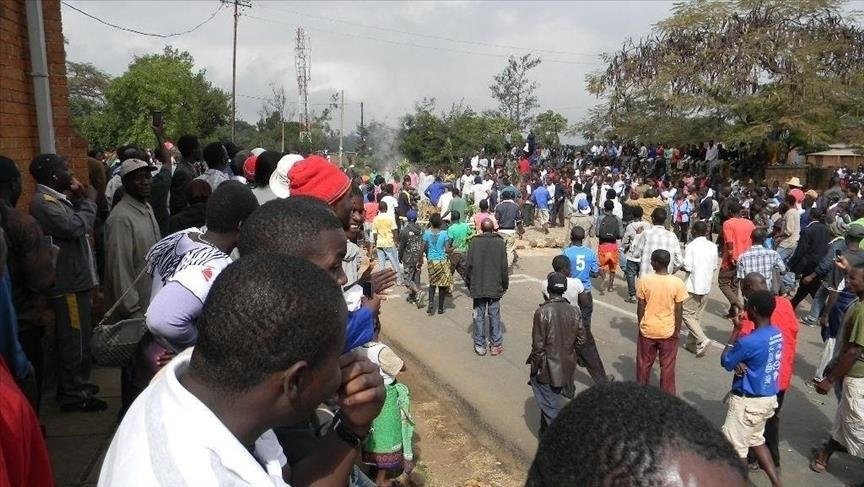
In Lilongwe, the capital of Malawi, police have detained 75 people, among them human rights activists, as part of a crackdown on protests against the country’s judicial system’s “selective justice.”
A last-minute high court injunction that sought to stop the demonstrations was followed by the arrests.
Hastings Chigalu, a spokesman for the police, confirmed the arrests on Wednesday and claimed that “lawlessness” was to blame for them, with people robbing stores, breaking into them, wrecking cars, and obstructing highways.
Kingsley Mpaso, one of the demonstration organizers, of the Lilongwe-based civil rights organization Human Rights Ambassadors told the media that his group was undeterred by the arrests and that demonstrators would continue to demonstrate until justice was served.
The activists are protesting what they perceive to be selective justice administered by the country’s judiciary in recent months in Southern Africa. They referenced the case of Mussa John, a youngster who was caught with cannabis and received an eight-year prison sentence from a magistrate’s court. A well-known businessman who was supposedly caught growing the plant in his compound merely received a fine from the courts.
This sparked controversy when people on social media pointed out the inconsistencies in the decisions, sparking demonstrations and a high court review of John’s case.
Authorities claim that the activists went on a vandalism rampage as the heavily armed police attempted to disperse the hundreds of protestors who had assembled. According to witnesses, the police used tear gas to scatter the gathering.
A number of ongoing legal matters, such as the one involving Norman Chisale, a former bodyguard of former President Peter Mutharika, who has been charged with corruption after failing to account for his large riches, are among the other complaints of the campaigners.
The trial of former minister of the lands Kezzie Msukwa, who has been implicated in kickbacks for contracts worth more than $150 million, has been delayed, which has angered protesters as well. Even though some of the scandal’s top officials have been suspended by President Lazarus Chakwera, the protesters urged swift public trials.
Despite a court order issued just hours earlier to cease the protests by a group of so-called “concerned citizens,” they continued. Authorities reportedly also requested a list of names of those who would serve as guarantors for the peaceful demonstrations.
However, attempts to stop the protests resulted in horrific scenes as people blocked roads and set fire to car tires throughout the city.
Alexious Kamangila, a human rights advocate and lawyer based in Lilongwe, told that the protest organizers met all legal conditions for holding protests.
He declared that the injunction prohibiting the demonstrations was regrettable since it lacked legal support. “New standards that are not specified by our laws have been established by the court. For instance, when all that is required by law is information on the conveners, the court cannot order the conveners to submit the identities of the participants to be held accountable, Kamangila stated.
Because these are public demonstrations, he questioned, “How does the court expect the conveners to obtain the identities of participants in advance when people just turn up on the day?”
