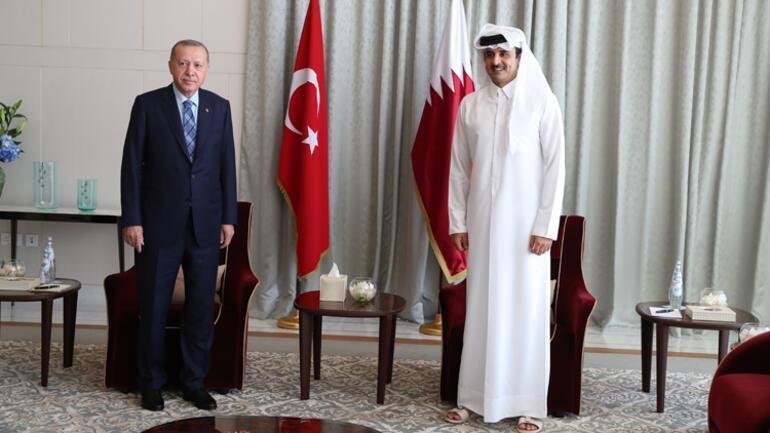
Erdogan visits Qatar: Erdogan will visit Qatar to attend a summit. The summit will include the signing of agreements in a range of categories, including culture, trade, investment, relief, sports, development, health, and religious issues, according to Mustafa Goksu, Turkey’s ambassador to Qatar.
Since the inaugural meeting of the Supreme Strategic Committee in 2015, the two countries have signed dozens of agreements. According to Goksu, trade between Doha and Ankara is anticipated to rise this year over previous.
Thousands of Turkish soldiers are stationed in Doha, the country’s sole military facility in the Gulf. Several hundred Qatari personnel and 36 fighter jets are scheduled to be temporarily sent to Turkey as part of an effort to improve Doha’s air force training.
As Erdogan visits Qatar, it is expected that both countries will also discuss bilateral relations.
Turkey’s foreign currency reserves have been drained as a result of an economic crisis and rapid lira depreciation, and Qatar currently provides it with the equivalent of $15 billion in currency swaps, up from $5 billion after talks between the two countries in May 2020.
After Saudi Arabia, the United Arab Emirates, Bahrain, and Egypt put a blockade on Qatar in 2017, the two countries grew closer. Saudi Arabia, the United Arab Emirates, and Egypt have accused Qatar of interfering in their internal affairs and supporting groups linked to the Arab Spring uprisings in 2011.
The blockading countries broke diplomatic connections, as well as trade and travel with Qatar, prompting fears of interruptions to basic imports such as food.
Within days, however, Qatar and Turkey had reached an agreement on fresh import agreements, with Qatar flying in a variety of important Turkish items. Soon after, Turkey announced that it would send hundreds of extra troops to its military station in Qatar.
Sheikh Tamim attended a Gulf Cooperation Council session in Saudi Arabia after the blockade was removed in January of this year.
According to Bulent Aras, adjunct professor at Qatar University’s Gulf Studies Center and professor of international affairs at Sabanci University’s Istanbul Policy Center, Turkey appears to be attempting to repair relationships with Gulf states in recent months.
“Turkey and Qatar see eye to eye on almost each and every issue in the Middle East, and it is worth pointing out that this rapprochement between Turkey and the GCC happened only after the Gulf crisis was over, at least on paper,” he told the news agency. “So you can guess there was coordination between Turkey and Qatar on the rapprochement issue and its timing.”
When Abu Dhabi’s crown prince, Sheikh Mohammed bin Zayed Al Nahyan, met Erdogan in Ankara last month and inked multiple agreements, including billion-dollar investment projects, a much-needed injection of foreign money amid Turkey’s crisis, a thaw appeared on the horizon.
There is additional evidence that the two countries relations are improving. Mehmet Ali Ozturk, a Turkish businessman who had been detained in the United Arab Emirates since 2018 on suspicion of financing “terrorist” organizations in Syria, was released and returned to Turkey. Sedat Peker, a convicted Turkish crime boss whose spectacular online recordings released from exile in Dubai included scandalous charges against top Turkish officials, has also been captured by UAE police and could be transferred to Turkey, which has been seeking his extradition for a long time.
After Erdogan visits Qatar, he is scheduled to visit the United Arab Emirates in February and has recently stated that Turkey is exploring rapprochement with Egypt and Saudi Arabia.
The Turkish president has previously spoken out against Egyptian President Abdel Fattah el-Sisi and how he came to power in a 2013 military coup, according to Ankara. Soon after el-Sisi took power, the two countries withdrew their ambassadors from each other’s capitals.
Turkey and Saudi Arabia have had tense relations since the assassination of journalist Jamal Khashoggi by a team of Saudi operatives in the Saudi consulate in Istanbul in October 2018. However, they appear to be softening as well; a Turkish court investigating Saudi officials in absentia in connection with the murder indicated it would not retry defendants if Riyadh has previously prosecuted them.
Turkey’s move was influenced by a number of factors, including a perception that Ankara is militarily stretched due to its abroad commitments. Erdogan is attempting to disentangle himself from problematic international problems and invite foreign investment into the country to try to prop up a collapsing economy as Turkey’s elections in 2023 approach, he added. “If elections are on the horizon, you’ll need a calmer climate, and you’ll need to keep your international and domestic policies under control.”
He went on to say that the regional countries’ response appears to be motivated by a desire to separate political ambitions from pragmatic considerations like economic cooperation.
While Qatar and Turkey collaborate on practically all topics, there has recently been a source of stress, according to Aras.
Ankara maintains that its maritime rights, as well as those of Turkish-backed Northern Cyprus, extend to claims made by Greece, Egypt, and Libya in the Eastern Mediterranean. Important oil and gas reserves, as well as drilling rights, are at stake.
The Turkish foreign ministry slammed the government of the Republic of Cyprus for agreeing to grant Exxon Mobile and Qatar Petroleum exploration licences last week.
According to Aras, Turkish diplomats anticipate that disagreements will not escalate into broader economic or military difficulties or a full-fledged conflict in the future.
“The countries in this geography are trying to at least compartmentalize relations, so they can have good economic relations but differences in, for example, Libya or the Eastern Mediterranean,” Aras said. “This is a kind of result of a learning process, and they recognize they cannot be in conflict at all levels on all issues.”
