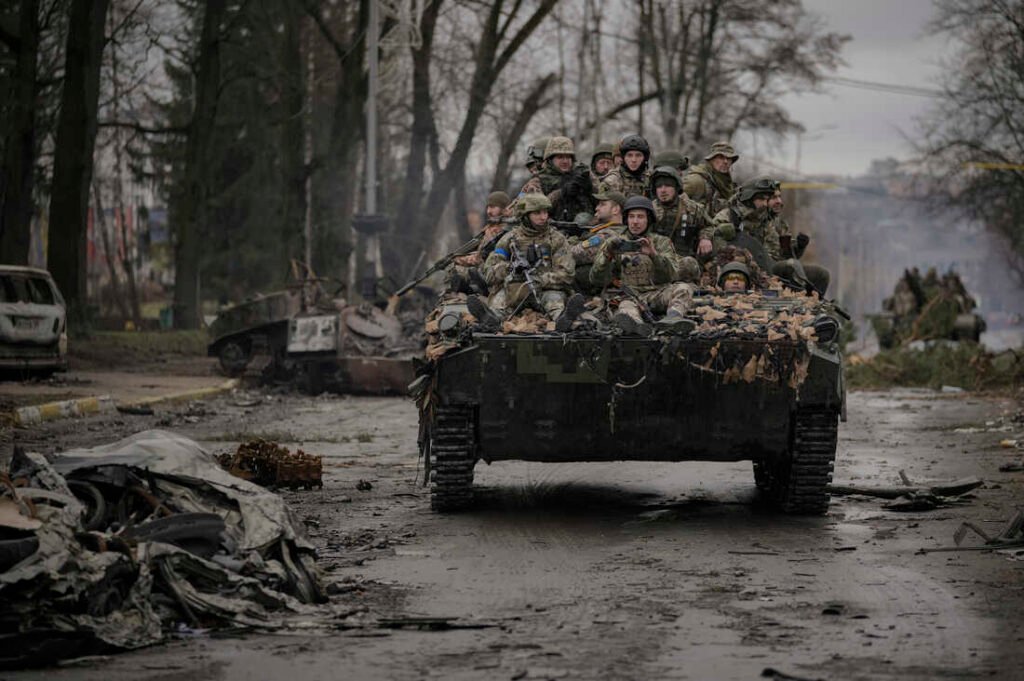
It has been six months since the Russian invasion of Ukraine. President Biden’s unwavering determination to “Save Ukraine” by gifting it fire powers can even prolong this war. How long this war will go is anybody’s guess. But its impacts have already encompassed the globe mainly in form of rising in petroleum products and wheat shortages. This crisis was simmering up for decades, and Russia repeatedly raised concerns over the expansion of NATO along its eastern borders. Ukraine seeking the ambit of NATO against aggression by Russia but no move is still in embryonic stage to include Ukraine in the western collation.
The Russia-Ukraine conflict is expanded over the span of a century. Both Ukraine and Russia share a tangled history that connects and divides them. Ukraine first asserted independence as Ukrainian People’s Republic in 1917 after centuries-long wielded jurisdiction of the Russian, Poland, Lithuania, and Austro-Hungarian Empires. Ukrainian people fought with Bolshevik Red Army to form Ukrainian People’s Republic after fighting a brutal civil war. When they were defeated, Ukraine was merged as the Ukrainian Soviet Republic into United Soviet Socialist Republics (USSR) in 1922. This short-lived but hard-fought battle of independence suggests that Ukrainian sought independence much earlier than WW-II.
During 1932-1933, Holodomor, the Ukrainian litany of starvation and inflicting death was regarded as an attempt to genocide precisely targeting Ukrainian farmers. Under Soviet rule, man-made famine was inflicted on targeted people through catastrophic socio-economic policies aimed to punish independent-minded Ukrainian and replace Ukraine’s minor farms with state-run collectives. Stalin, the ruler of the USSR wanted to rapidly change Ukraine into a socialist nation. To meet this aim he introduces collectivization by replacing individual owners of small farms with state-owned collectives. Ukrainian farmers resisted this and it is believed that around 50,000 Ukrainian farmers were deported to Siberia forcefully to implement authoritarian orders. In an attempt to repopulate and demographically change eastern borders, Stalin imported soviet citizens from different parts who were completely unfamiliar with the Ukrainian language in the eastern region. For this reason, eastern Ukraine is still pro-Russian more likely to support Russia-inclined politicians than western Ukraine which spent centuries under the shifting control of European powers.
The fragile Ukrainian Republic was annexed and backed by Russia in World War II when Russia was battling Hitler’s German forces. Russian President Vladimir Putin claims that the Ukrainian independence movement began during WW II when Ukraine was under Nazi forces and some Ukrainian freedom fighters aligned themselves with Nazis. Ukraine thus saw Nazi forces as their savior and on this bases, Russia often falsely try to paint Ukraine as Nazi Nation and any attempt at sovereignty as Nazi-motivated.
Seeing Nazis through the prism of their independence and as saviors from Russian atrocities, Ukrainian commoners supported even Holocaust. It is said that around one out of four Jewish were killed in Kiev. It was not the case that Ukraine wanted independence from Russia to merge with Germany. They actually wanted to end the suffering inflicted upon them by Stalin’s tyrannical rule.
After the collapse of the USSR, the majority of Ukrainians voted in favor of independence from Russia in the 1991 referendum. Ukraine after WW II blurred the historic divide between its western and eastern half and perhaps this was the first step towards increasing Ukrainian nationalism and the reason why the majority even in the eastern presumably Russian-influenced region voted for a separate nation from USSR.
Ukraine after parting ways from USSR observed two revolutions: one in 2005 and the revolution of dignity in 2014. Both revolutions were against Russian supremacy and seek ways to join the EU and NATO. After the Revolution of Dignity in 2014, Viktor Yanukovych, the Russia-backed Ukrainian president was removed and Russia using a political vacuum annexed Crimea and backed rebels in Ukraine’s southeast parts of Donetsk and Luhansk where the death penalty was restored and dozens of concentration camps were operated to torture and execute dissidents.
Russia undermined and miscalculated increased Ukrainian Nationalism and expected a brief resistance in western Ukraine. However United Nations chief presaged that the war may prolong for the span of years. The reaction of the world, although much compromised on fuel and wheat trade with Russia is still much more than Russia have expected. Reverberations of war are already being felt in every continent of the world. Fuel prices hiked, food insecurity soared and trade declined by multiples. War has already claimed thousands of lives and millions of Ukrainians are displaced. More than $42 billion have been spent on the assistance of Ukraine.
The Question of prime importance now is how this war will end? It has been almost half a year since the invasion and still, Russia hasn’t managed to oust Volodymyr Zelensky from the office. Russian forces are now more concentrated in Donbas and it seems that Russia is determined to move slowly and firmly after the first failed attempt to enter Kiev. At the end of every war, one country has to surrender or both countries have to come to the negotiation table.
One less possible outcome is the Ukrainian victory in the Russia-Ukraine conflict. But first, we have to define what will be the victory for Ukraine. Will Ukraine stop if able to push Russia back to February 22 land demarcations or further will peruse to take back Crimea which was annexed by Russia in 2014? Some may define Ukrainian victory as fighting till Russia loses military capabilities and Putin is removed from office so that Russia may not be able to resume war again which was started in 2014 initially. But Russia has overwhelmed military power when compared with Ukraine. Ukraine forces are not even able to throw out the Russian powerful military from Ukraine.
Russia’s strategic position over Ukraine has not changed. Putin repeatedly termed Ukraine a failed state and Putin continually claimed that Russia, Ukraine and Belarus are one People: the people of Rus. Putin’s intentions to completely eliminate the sense of Ukraine’s nationalism are not hidden. But Russia has apprehension that Ukrainian nationalism cannot be entirely exterminated. This second extreme result of the conflict is also less likely.
One possible outcome is the stalemate situation in the Russian-Ukraine conflict and the situation is meteorically moving towards this. Ukraine has stepped back from the rigid position and is ready to accept neutrality between Russia and NATO. Western response to
The invasion was exemplary, and military aid and humanitarian assistance were robust but this aid and assistance are likely to soften in the future. Russia has a history of freezing active conflicts and a recent exemplar of this is the Russian intervention in Syria. Russia has already taken control of Donbas, Important ports along Ukraine’s sea shores and significant agricultural plains. Russia may freeze this conflict at this point as economic and trade sanctions are hurting the economy considerably and the cost of war and Ukraine’s resistance is growing with the passage of time. Demilitarization over Ukraine-Russian Borders is the only way out to strategically weaken Putin’s justification for Invasion and weaken the support for war domestically.
Finally, the World’s response against any kind of aggression should not be based on the bases of religion, ethnicity, colors, and region. The invasion should be condemned equally, whether it is against the people of Ukraine or the People of Palestine. Otherwise, classifying good and bad invaders will only undermine the peace of the world and the world will witness more aggressions in not far distant future.
